
From scattered AI tools to a unified AI operations platform
AI Operations
SaaS B2B
Overview
AI subscriptions, token usage, and adoption data were spread across multiple tools, making it difficult to track costs, identify inefficiencies, and forecast spend. This case study unifies governance, optimization, and financial oversight into a single platform for smarter AI management.
Spend Waste
Reduced unnecessary subscription and token expenditure.
Visibility Gaps
Eliminated fragmented AI usage and spend tracking.
Cost Governance
Centralized monitoring of budgets, forecasts, and usage.
Optimization Insights
Actionable recommendations to improve efficiency and adoption.
Role
End to end product design
Tools



Contributors

Problem
AI adoption accelerates when teams move fast, but governance struggles when spend, usage, and ownership become fragmented
As AI tools became embedded across teams, organizations gained productivity but lost visibility into how those investments were being used. Subscription costs, token consumption, and adoption data were spread across multiple platforms, making it difficult to track spend, identify inefficiencies, and understand ownership. Without a centralized system, finance and operations teams relied on fragmented reports and manual reviews, limiting their ability to forecast costs, control budgets, and make confident decisions about AI investments.


Research & Discovery
Conversations with team managers revealed that AI adoption was growing faster than the organization’s ability to govern cost, utilization, and business value
01
AI spending grows quietly across teams
New AI tools are often introduced by individual teams to solve immediate productivity challenges. Over time, subscriptions accumulate across departments, creating a growing layer of spend that expands without a clear understanding of ownership, necessity, or overall business impact.
02
Cost visibility exists, value visibility does not
Managers can usually see invoices, subscription counts, and token usage. What remains difficult is understanding whether those costs translate into meaningful outcomes. As a result, renewal and budgeting decisions are often based on assumptions rather than measurable value.
03
Optimization becomes reactive instead of continuous
Without a unified view of adoption, utilization, and spend, opportunities to reduce waste are often discovered only during budget reviews or renewal cycles. By the time inefficiencies are identified, organizations may have already spent months paying for underutilized or overlapping tools.
Course of Action
Translating fragmented AI governance challenges into a structured system for visibility, optimization, and decision-making
The research revealed that organizations struggled not because AI adoption was low, but because visibility, ownership, and value were difficult to measure across an expanding ecosystem of tools. Based on these findings, I focused on defining the information architecture, workflows, and decision-support capabilities needed to help teams understand AI spend, identify inefficiencies, and optimize investments proactively.
01
Established a unified source of truth for AI operations
Consolidated spend, subscriptions, token usage, adoption, and governance insights into a single platform, eliminating the need to navigate multiple vendor dashboards and disconnected reports.
02
Structured the platform around key decision-making workflows
Defined information architecture and user flows around the questions finance, operations, and IT teams need answered most often: where money is spent, what creates value, and where optimization opportunities exist.
03
Prioritized actionable insights over raw reporting
Focused on surfacing meaningful recommendations such as duplicate tools, underutilized subscriptions, adoption gaps, and budget risks instead of overwhelming users with isolated usage metrics.
04
Used AI-assisted exploration to accelerate concept validation
Leveraged AI as a research and design partner to synthesize findings, evaluate solution directions, generate early workflow explorations, and rapidly iterate on wireframe concepts before moving into detailed design.
System Design
User Flow
The system was designed around the lifecycle of AI cost optimization, guiding users from identifying anomalies to understanding root causes and taking corrective action. Rather than separating analytics, subscriptions, and recommendations into disconnected experiences, the flow creates a continuous decision-making journey that helps teams uncover inefficiencies, validate opportunities, and capture measurable savings.

Information Architecture
The platform architecture was designed to transform fragmented AI management activities into a cohesive operational system. Core areas such as analytics, subscriptions, optimization, forecasting, workspace governance, and AI-assisted insights were structured around real user workflows rather than organizational silos. By grouping related decisions and actions together, the architecture reduces navigation complexity, improves discoverability, and enables users to move from understanding AI spend to taking optimization actions within a unified experience.

Initial Ideas
Exploring how complex AI governance workflows translate into usable interfaces
With the information architecture and core workflows established, I created multiple wireframe explorations to evaluate how analytics, subscriptions, forecasting, optimization, and AI-assisted insights should be organized across the product. These iterations focused on balancing high information density with usability, refining content hierarchy, validating navigation patterns, and ensuring users could quickly identify risks, investigate spend drivers, and act on recommendations without becoming overwhelmed by data.

Design System
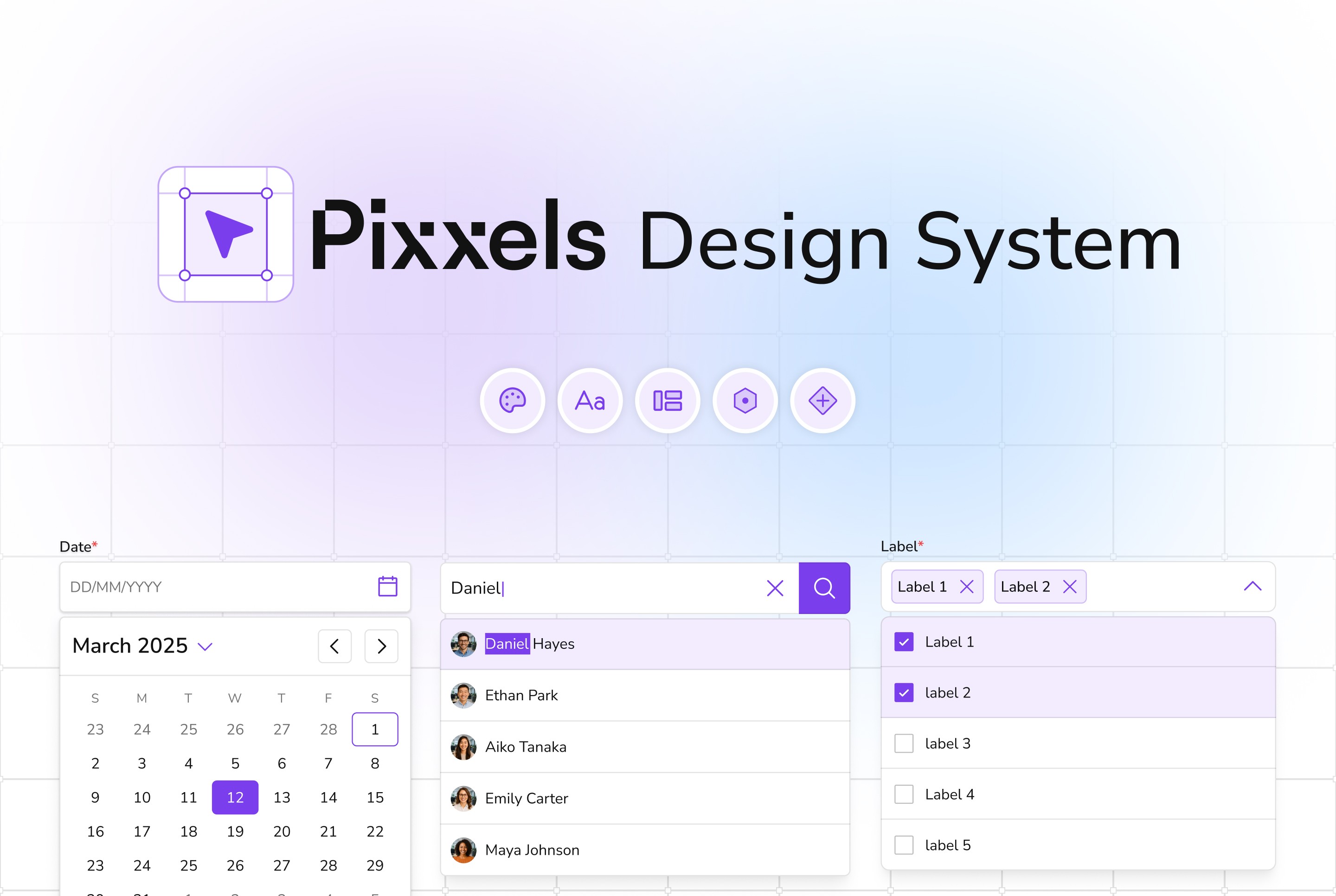
Creating a design system that supports complex analytics while keeping enterprise workflows easy to scan and understand
As the platform expanded across analytics, forecasting, subscriptions, governance, and AI-assisted workflows, maintaining consistency became critical. The design system was built to standardize visual patterns, interaction behaviors, and data presentation across the product. Particular attention was given to readability, semantic feedback, and accessibility, ensuring complex information remains easy to interpret while adhering to WCAG 2.1 AA standards.
Design Principles
Prioritized information hierarchy to help users quickly identify critical insights within data-dense interfaces.
Used consistent spacing, typography, and component patterns to reduce cognitive load across workflows.
Applied semantic color usage to clearly communicate system states, risks, recommendations, and outcomes.
System Consistency & States
A unified foundation was established for colors, typography, component states, and interaction patterns to create a predictable experience across the platform. Accessibility was considered throughout the system, with contrast ratios, visual states, and typography designed to meet WCAG 2.1 AA guidelines while supporting clarity across analytics-heavy screens.

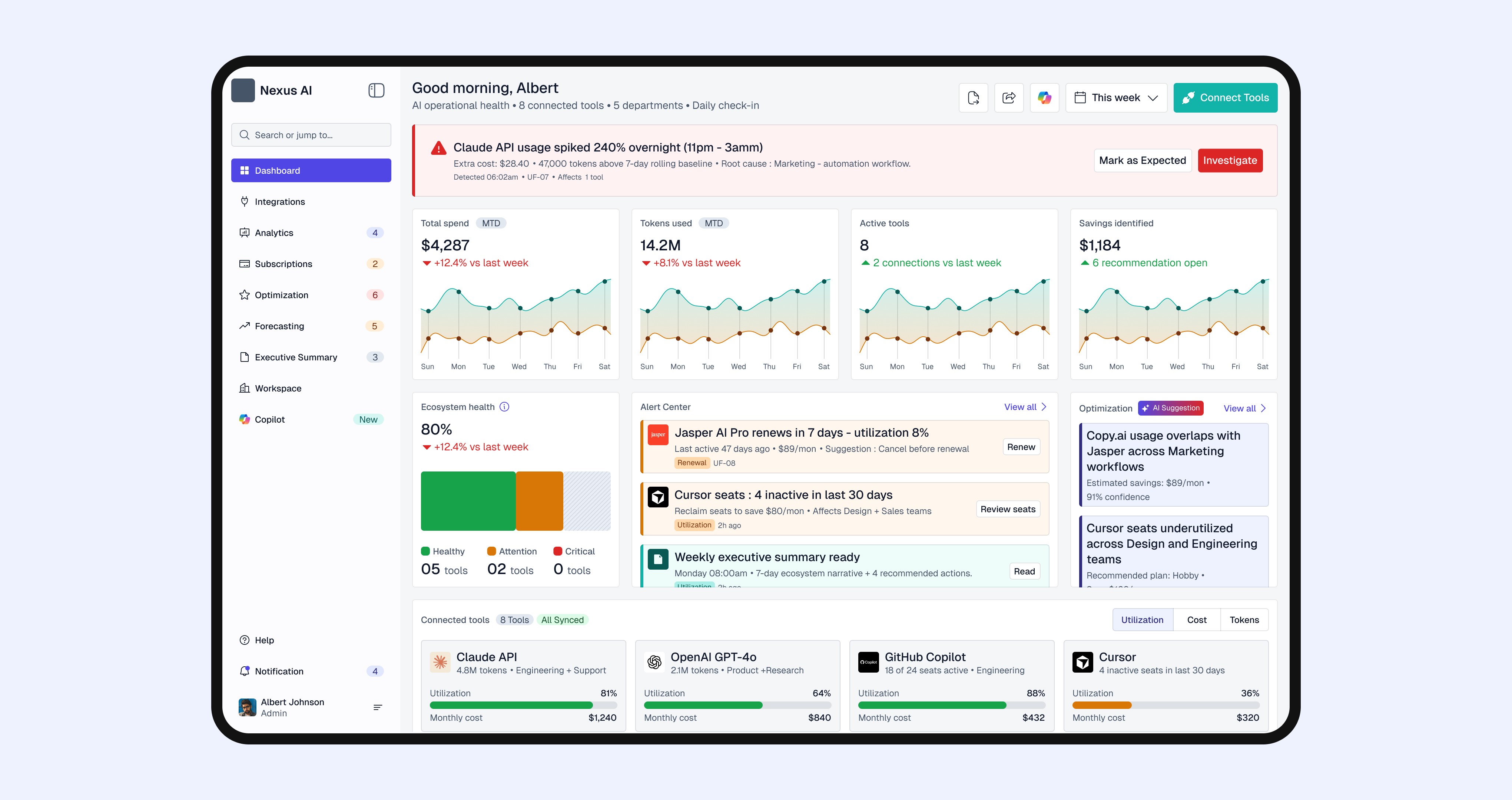
Dashboard
Surfacing anomalies, waste, and optimization opportunities before they become costly decisions
This dashboard was designed to help teams understand the operational health of their AI ecosystem at a glance. Rather than reviewing individual vendor portals, users can immediately see unusual spend activity, underutilized subscriptions, upcoming renewals, and optimization opportunities from a single workspace. The focus was on reducing investigation time and bringing attention to the signals that require action first.
Problem
AI costs often increase gradually through token spikes, duplicate tools, inactive seats, and overlooked renewals. Because this information lives across multiple platforms, teams typically discover inefficiencies only after budgets are exceeded or renewals are processed.
Solution
The dashboard proactively surfaces anomalies, utilization risks, renewal alerts, and AI-generated recommendations alongside spend and adoption metrics. This allows users to identify issues early and move directly into investigation or optimization workflows.
Rationale
Most operational decisions begin with identifying what changed. By prioritizing anomalies, health indicators, and actionable recommendations above detailed analytics, users can quickly understand where attention is needed without manually searching through reports.
Impact
Reduces the time required to detect cost inefficiencies, improves visibility into ecosystem health, and helps teams take corrective action before waste accumulates or unnecessary spending continues across the organization.
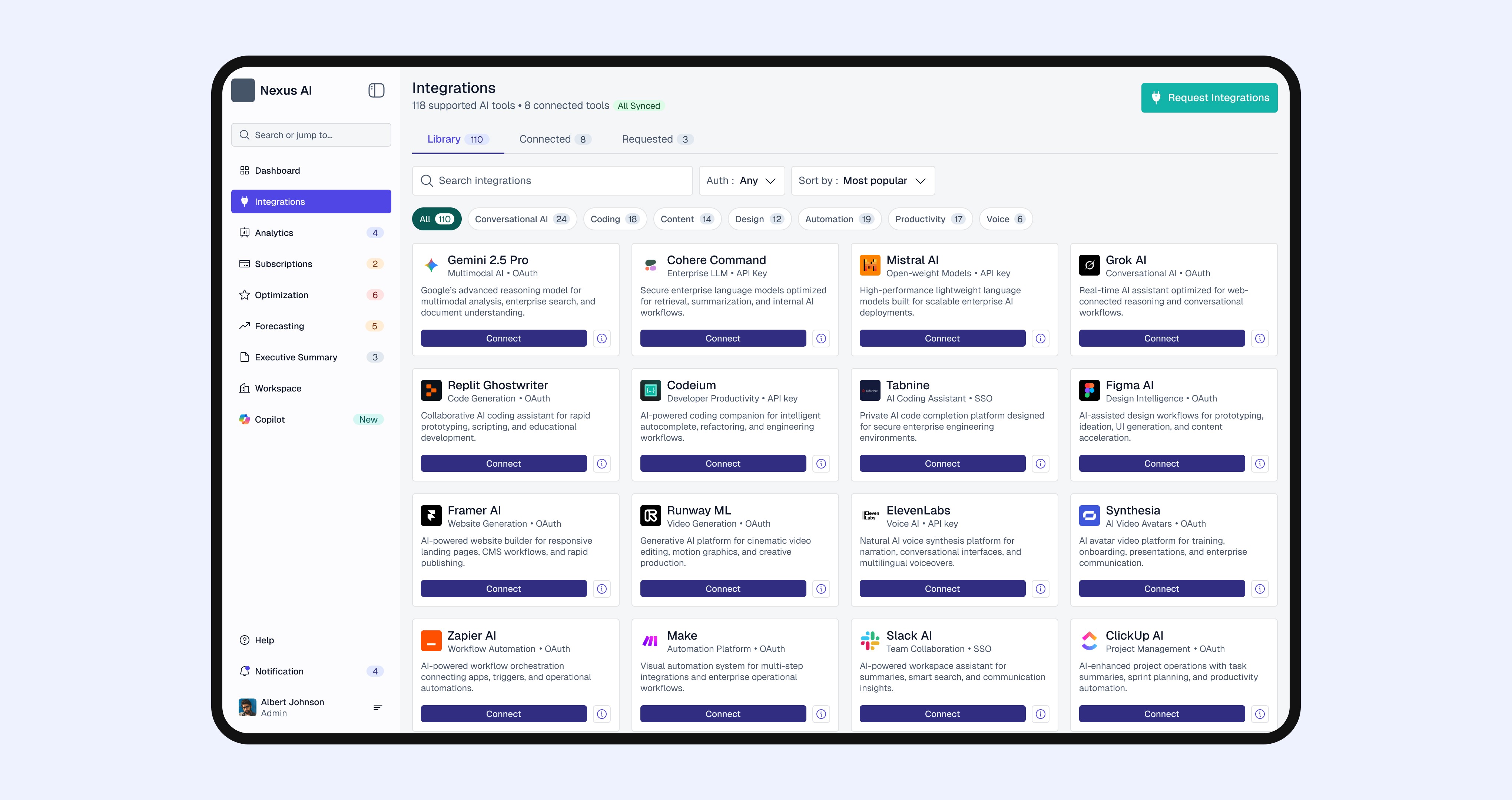
Integrations
Creating a centralized layer to connect, monitor, and govern AI tools across the organization
The Integrations experience was designed to solve one of the biggest challenges in AI governance: fragmented visibility. As organizations adopt multiple AI products across departments, understanding usage, cost, permissions, and operational health becomes increasingly difficult. This section allows teams to connect AI tools into a single ecosystem and continuously monitor their performance, utilization, and business impact.
Problem
AI adoption often happens independently across teams, resulting in disconnected tools, scattered usage data, and limited oversight. Without a centralized integration layer, organizations struggle to understand how tools are being used, who owns them, and whether they continue to deliver value.
Solution
The integration library provides a structured catalog for discovering and connecting AI tools, while dedicated tool-level views surface usage trends, token consumption, costs, permissions, and operational health. This creates a single source of truth for managing AI services across the organization.
Rationale
Connecting a tool is only the beginning of governance. Users also need ongoing visibility into how that tool performs after adoption. By combining integration management with operational monitoring, the experience supports both onboarding and long-term optimization within the same workflow.
Impact
Improves visibility across the AI ecosystem, reduces dependency on individual vendor dashboards, and enables teams to monitor utilization, identify inefficiencies, and make more informed decisions about tool adoption and ongoing investment.

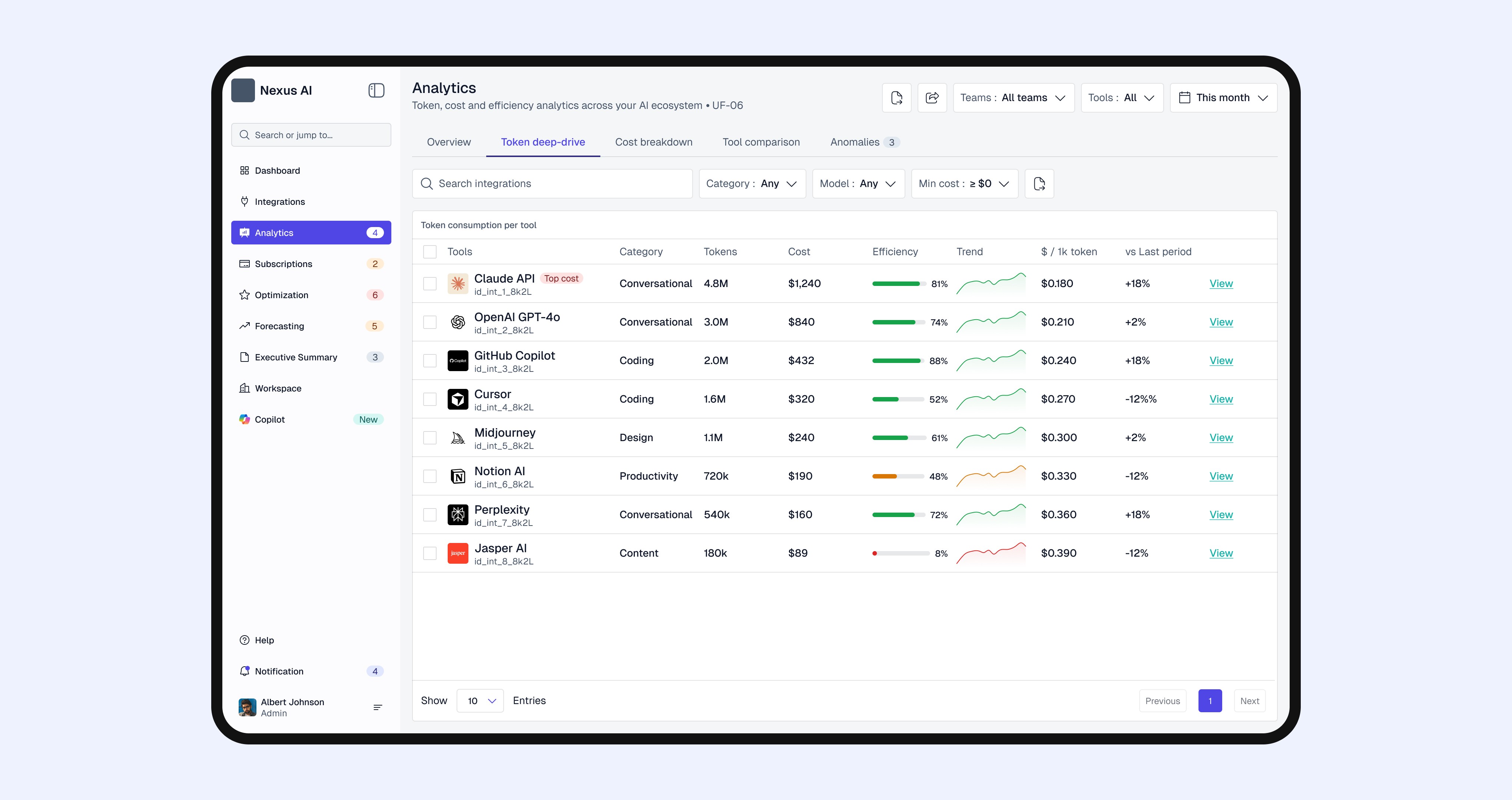
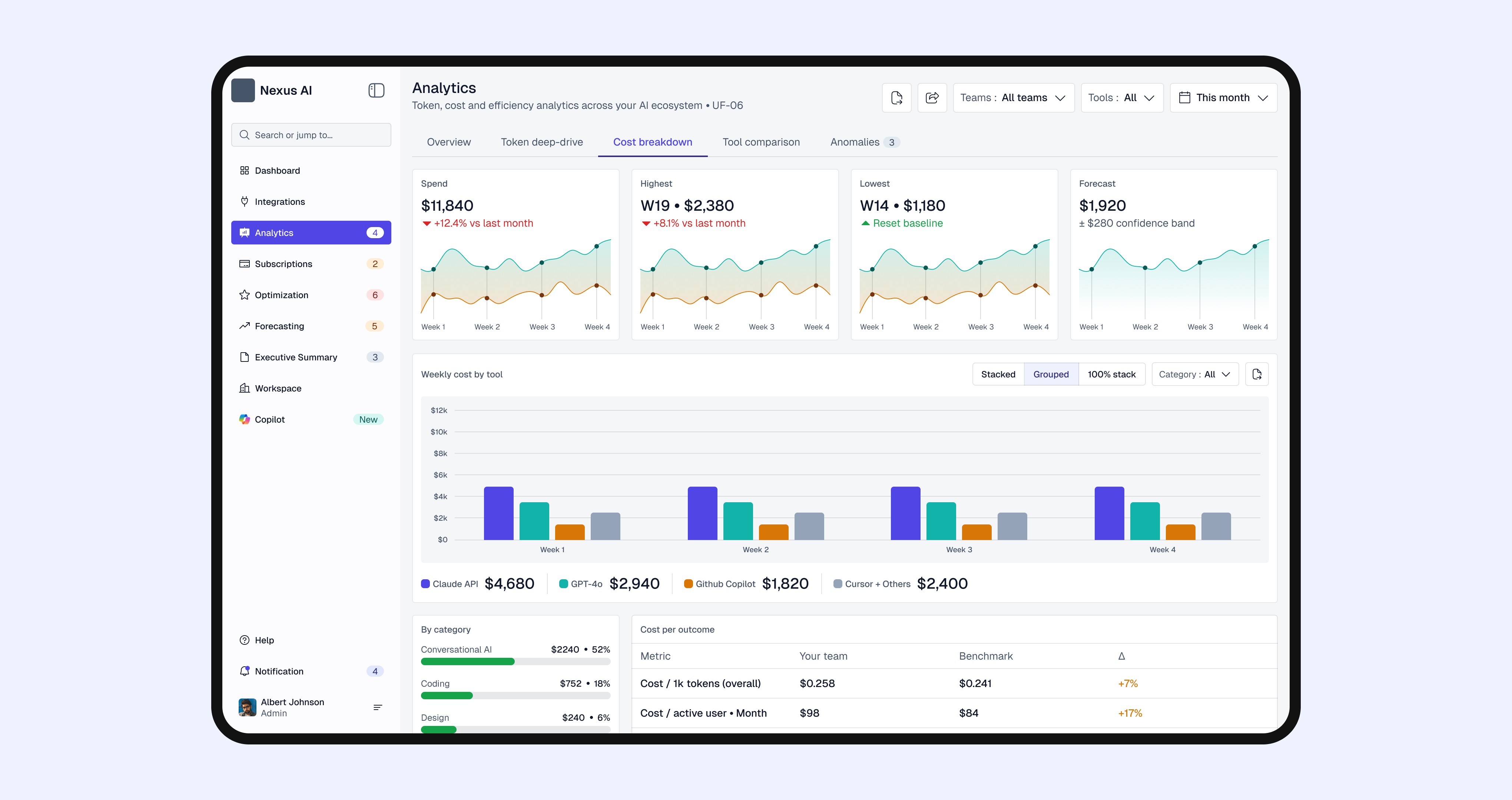
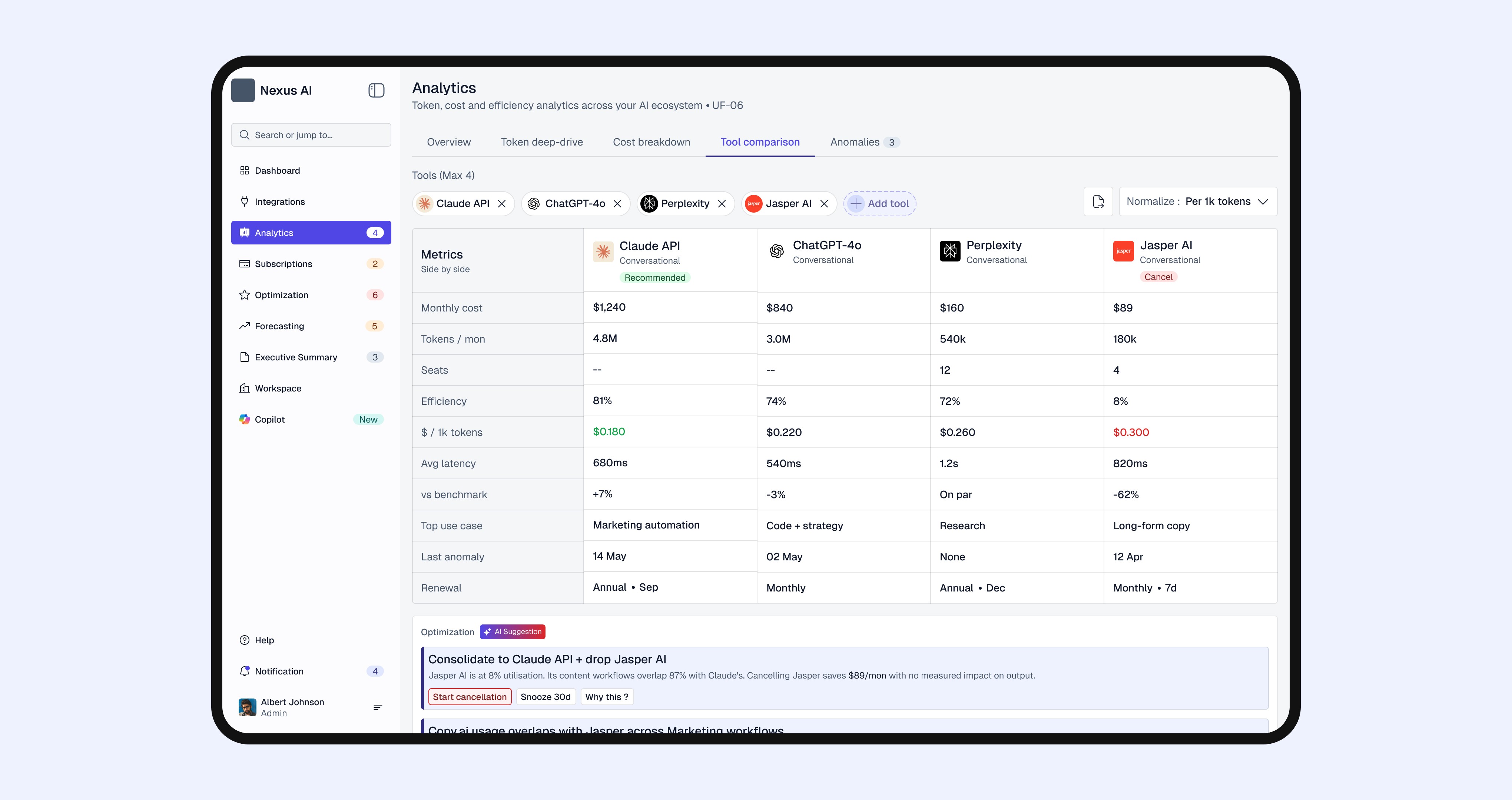
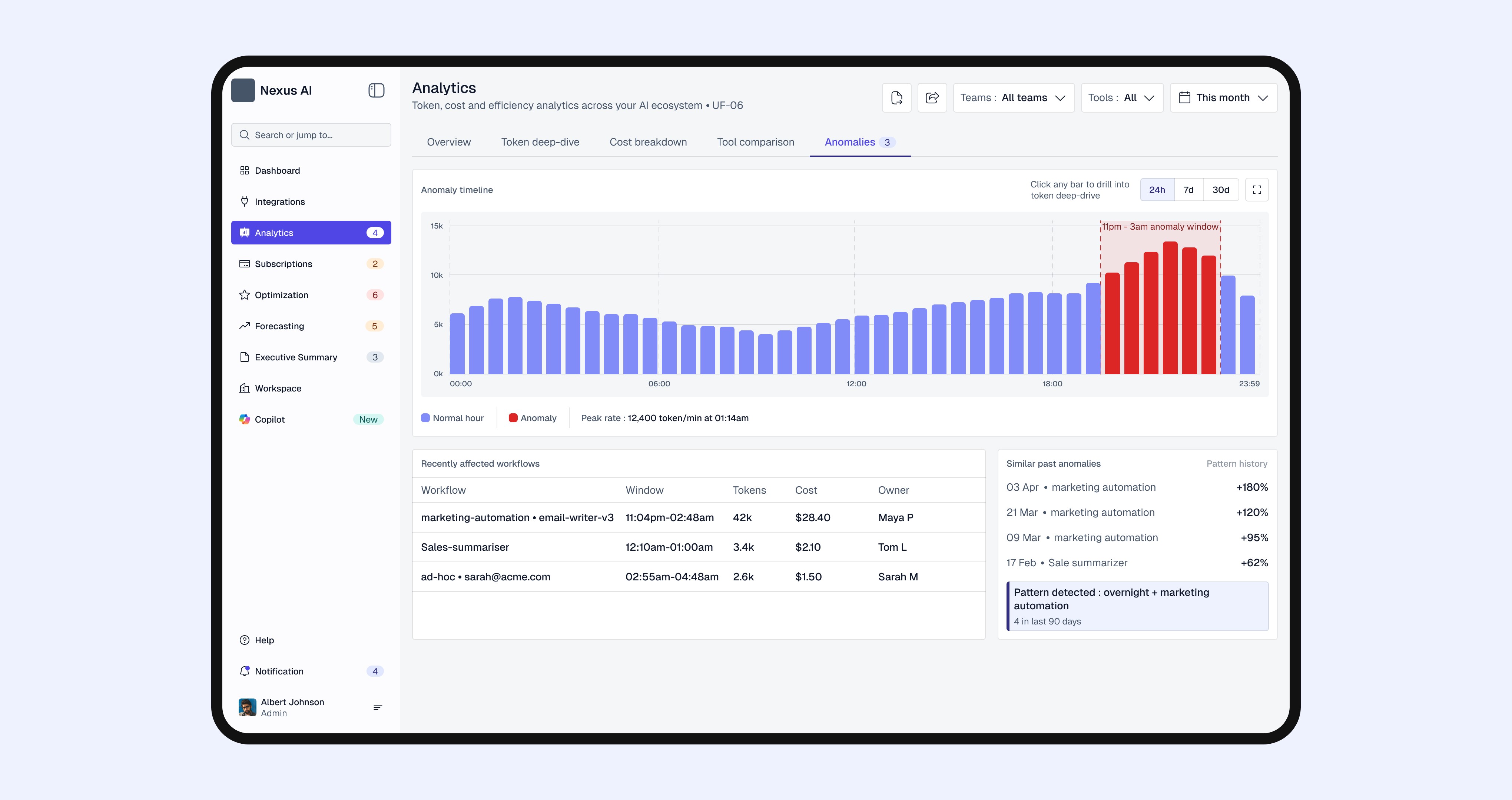
Analytics
Creating a structured analytics layer to understand AI spend, usage patterns, and optimization opportunities
As AI adoption grows, understanding where costs originate and how tools are being utilized becomes increasingly difficult. The analytics experience was designed to consolidate token usage, spend, efficiency metrics, tool comparisons, and anomalies into a single workspace. The focus was on helping teams move from observing metrics to identifying waste, understanding drivers, and making informed optimization decisions.
Problem
AI usage and cost data are often distributed across multiple vendor platforms. This makes it difficult to understand which tools drive spend, identify inefficiencies, compare performance, or detect unusual activity before it impacts budgets.
Solution
Designed dedicated analytics views for token consumption, cost breakdowns, tool comparisons, and anomaly detection, allowing users to investigate AI activity from ecosystem-level trends down to individual tool performance.
Rationale
Operational and financial decisions require more than reporting metrics. Structuring analytics around investigation workflows helps users move from identifying issues to understanding root causes and evaluating optimization opportunities.
Impact
Provides greater visibility into AI investments, surfaces inefficient usage patterns, highlights anomalies earlier, and enables teams to make data-driven decisions around spend, adoption, and tool effectiveness.

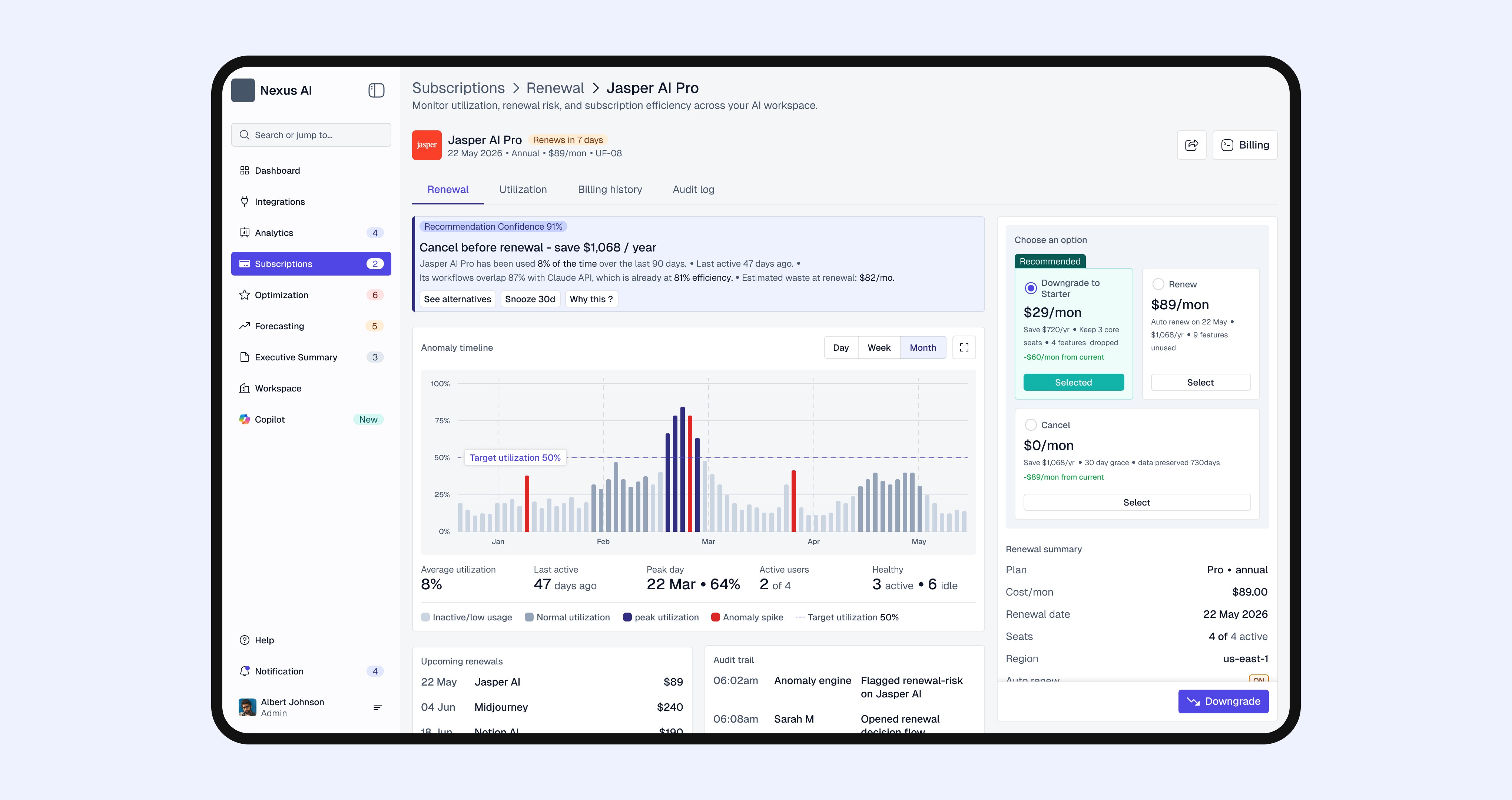
Subscription Management
& Renewal Decisions
Helping teams make renewal decisions based on utilization, value, and actual usage
As AI adoption increases, subscriptions often renew automatically without a clear understanding of utilization or business impact. This experience was designed to surface renewal risks early, combining usage patterns, activity history, overlap detection, and AI-driven recommendations into a single decision-making workflow. The goal was to replace reactive subscription management with proactive optimization and cost control.
Problem
Organizations frequently renew AI subscriptions without visibility into adoption, utilization, or overlapping capabilities. Teams struggle to determine whether a tool should be renewed, downgraded, consolidated, or removed before renewal deadlines occur.
Solution
Designed a renewal workspace that combines utilization analytics, renewal timelines, audit history, and AI-generated recommendations, enabling users to evaluate subscription value and take action directly from the decision flow.
Rationale
Renewal decisions are financial decisions. Presenting usage evidence, cost implications, activity patterns, and alternative options together reduces uncertainty and helps users justify optimization actions with confidence.
Impact
Improves subscription governance, reduces unnecessary renewals, surfaces underutilized tools before renewal dates, and enables organizations to capture savings opportunities without disrupting active workflows or teams.
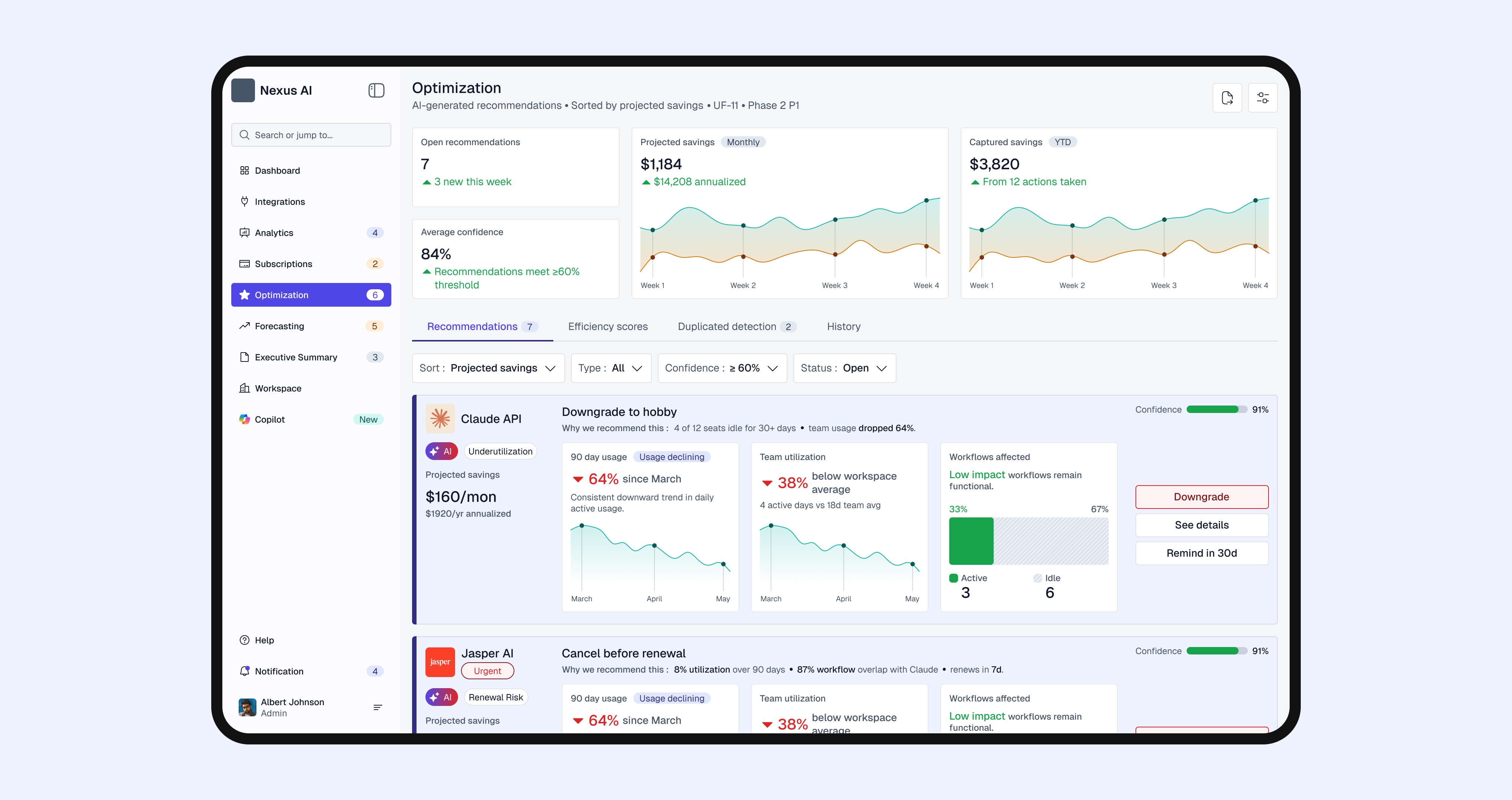
Optimization Engine
Turning AI usage insights into actionable recommendations that reduce waste and improve efficiency
Collecting usage data alone does not help organizations optimize AI investments. The optimization experience was designed to convert analytics into clear, evidence-backed recommendations that identify underutilized tools, overlapping subscriptions, and cost-saving opportunities. The focus was on helping teams confidently act on optimization opportunities rather than manually interpreting large volumes of operational data.
Problem
Organizations often recognize inefficiencies only after costs have accumulated. Identifying underutilized tools, duplicate subscriptions, and optimization opportunities typically requires manual analysis across multiple reports and disconnected systems.
Solution
Designed an AI-powered recommendation layer that continuously evaluates utilization, adoption trends, overlap signals, and renewal risks to generate prioritized optimization actions with projected savings and confidence scores.
Rationale
Optimization decisions require trust. Presenting supporting evidence, usage trends, projected impact, and affected workflows alongside each recommendation helps users understand why an action is suggested before taking action.
Impact
Reduces manual analysis effort, surfaces cost-saving opportunities earlier, improves subscription efficiency, and enables organizations to capture measurable savings through proactive optimization rather than reactive cost management.
Forecasting & Budget Planning
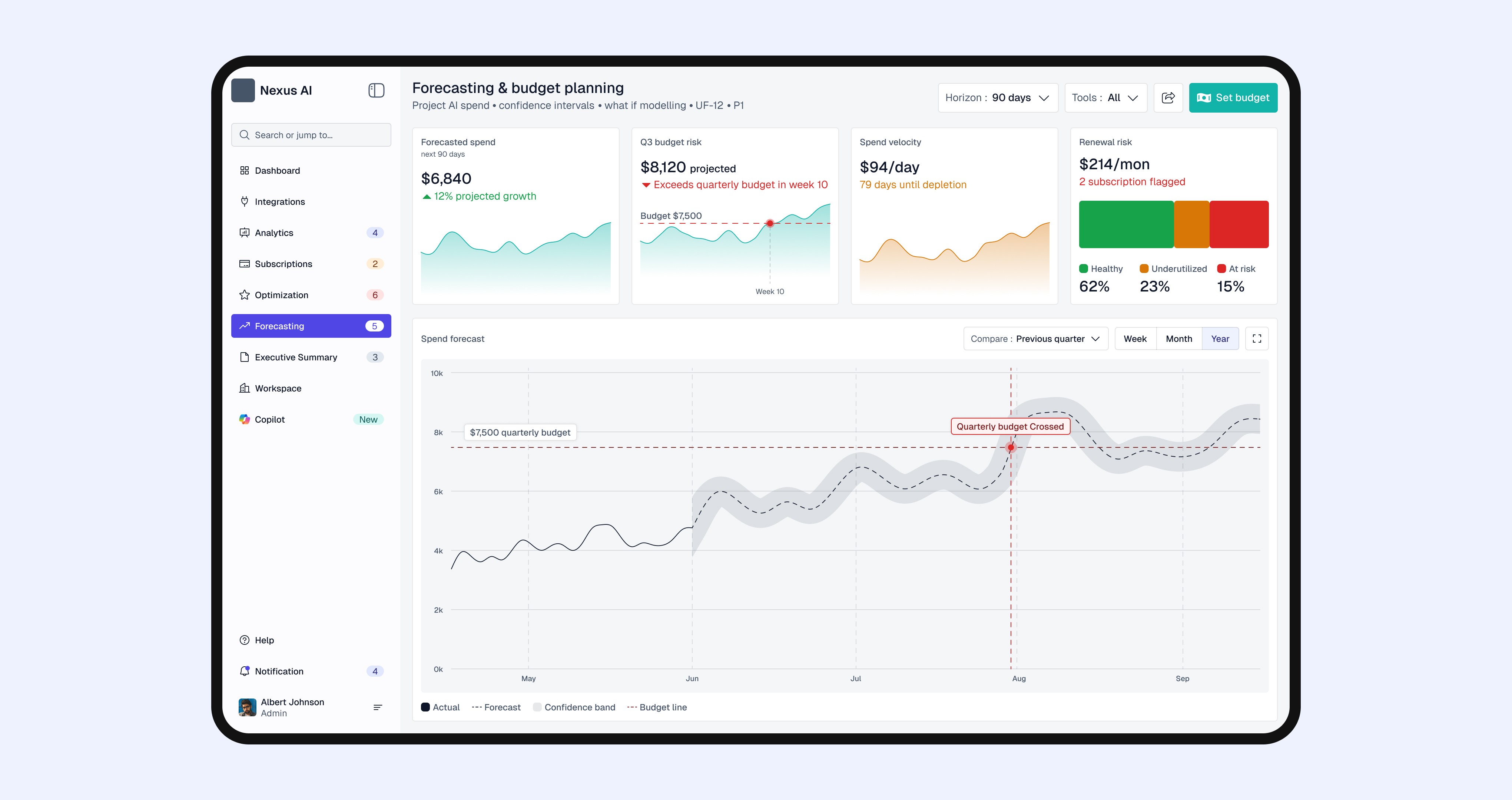
Enabling teams to anticipate future AI spend and prevent budget overruns before they occur
Managing AI costs becomes increasingly difficult when decisions are based only on historical data. The forecasting experience was designed to help teams understand future spending trajectories, renewal exposure, and budget risks before they impact operations. The focus was on shifting cost management from reactive reporting to proactive planning through predictive insights and scenario-based decision making.
Problem
Organizations often discover budget overruns after costs have already accumulated. Without forecasting capabilities, teams struggle to anticipate spend growth, renewal impacts, and future financial risks across their AI ecosystem.
Solution
Designed a forecasting workspace that combines spend projections, confidence intervals, budget thresholds, renewal risk indicators, and future growth trends to support planning and budget allocation decisions.
Rationale
Financial planning requires visibility into what is likely to happen, not just what has happened. Presenting projected spend alongside budget limits and risk signals enables users to identify potential issues early and adjust accordingly.
Impact
Improves budget predictability, surfaces future cost risks before they occur, supports more accurate planning decisions, and helps organizations maintain control over AI spending as adoption scales across teams.
Executive Summary
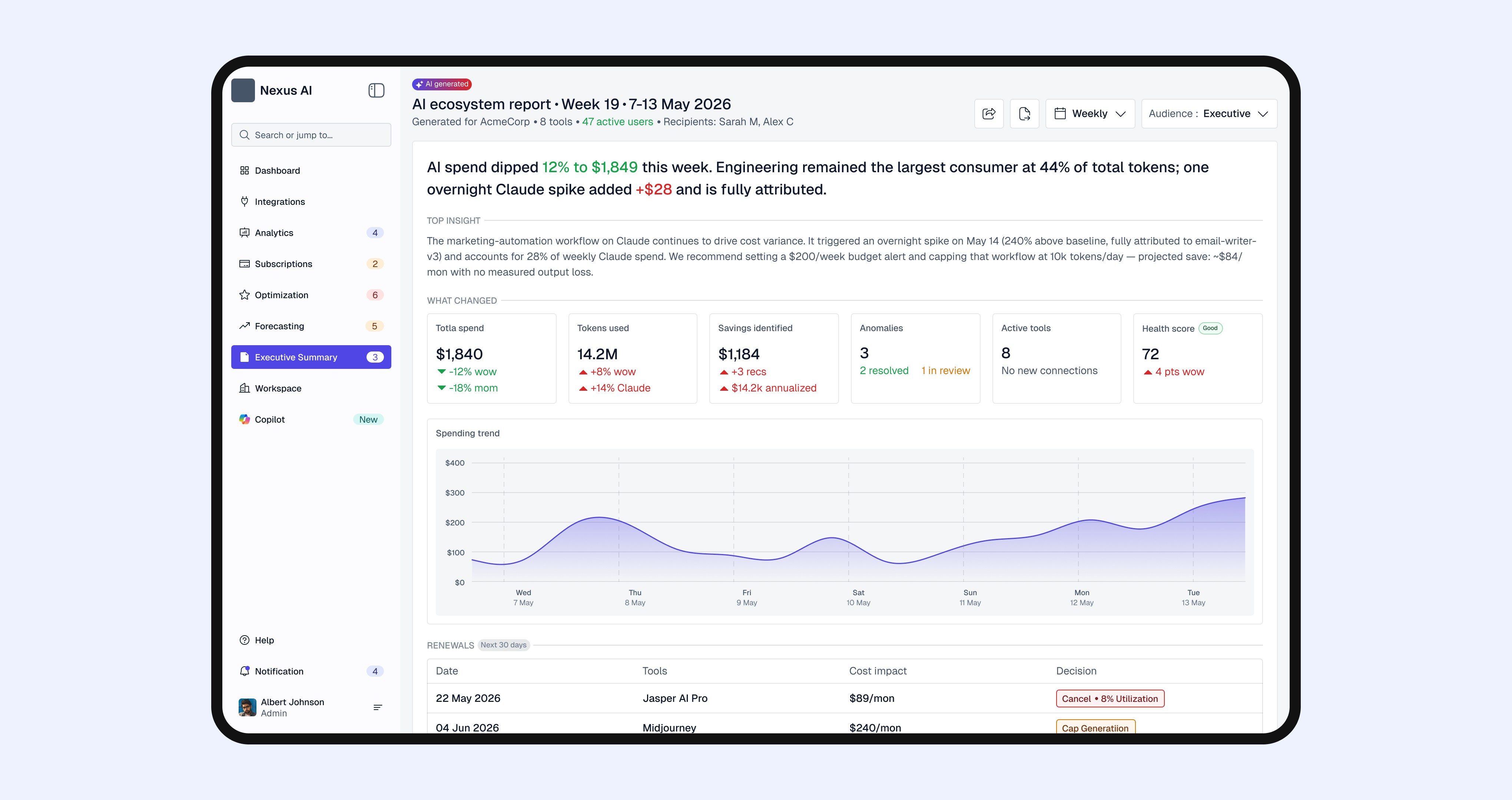
Converting complex AI usage data into executive-ready insights and recommended actions
Stakeholders often need clear answers without navigating detailed analytics dashboards. The Executive Summary experience was designed to transform operational data into concise narratives that highlight spending trends, key changes, optimization opportunities, and business risks. The focus was on helping decision-makers quickly understand what happened, why it happened, and what actions should be prioritized next.
Problem
AI spending, adoption, and optimization data are distributed across multiple workflows and reports. Executives often lack a simple way to understand ecosystem performance, emerging risks, and high-impact decisions without reviewing detailed analytics.
Solution
Designed an AI-generated reporting experience that consolidates ecosystem health, spending trends, anomalies, renewals, and optimization opportunities into a structured executive briefing with actionable recommendations.
Rationale
Leadership teams require insights rather than raw metrics. Presenting key changes, cost drivers, business impacts, and recommended actions together enables faster understanding and more informed decision-making.
Impact
Reduces reporting effort, improves visibility into AI investments, aligns stakeholders around key priorities, and helps organizations make strategic decisions using a consistent view of ecosystem performance and optimization opportunities.
Workspace Management
Providing visibility into team-level AI adoption while maintaining governance, access control, and operational accountability
As AI usage expanded across departments, organizations needed a way to understand how tools were being adopted, where spending was concentrated, and who had access to critical systems. The Workspace module was designed to combine departmental insights with centralized user management, enabling teams to monitor adoption patterns, identify inefficiencies, and maintain control over permissions at scale.
Problem
AI adoption often grows unevenly across departments, making it difficult to track usage patterns, identify overlapping tools, and manage user access. Teams lacked a centralized view of organizational adoption and governance.
Solution
Created a workspace management experience that combines department-level analytics, adoption monitoring, duplicate tool detection, and role-based access management within a single operational environment.
Rationale
Understanding usage at both team and individual levels helps organizations balance adoption, spending, and governance. Centralizing these controls reduces administrative overhead while improving visibility across the ecosystem.
Impact
Enables better resource allocation, improves oversight of AI adoption across departments, strengthens access governance, and helps organizations scale AI usage with greater operational control and accountability.


AI Copilot
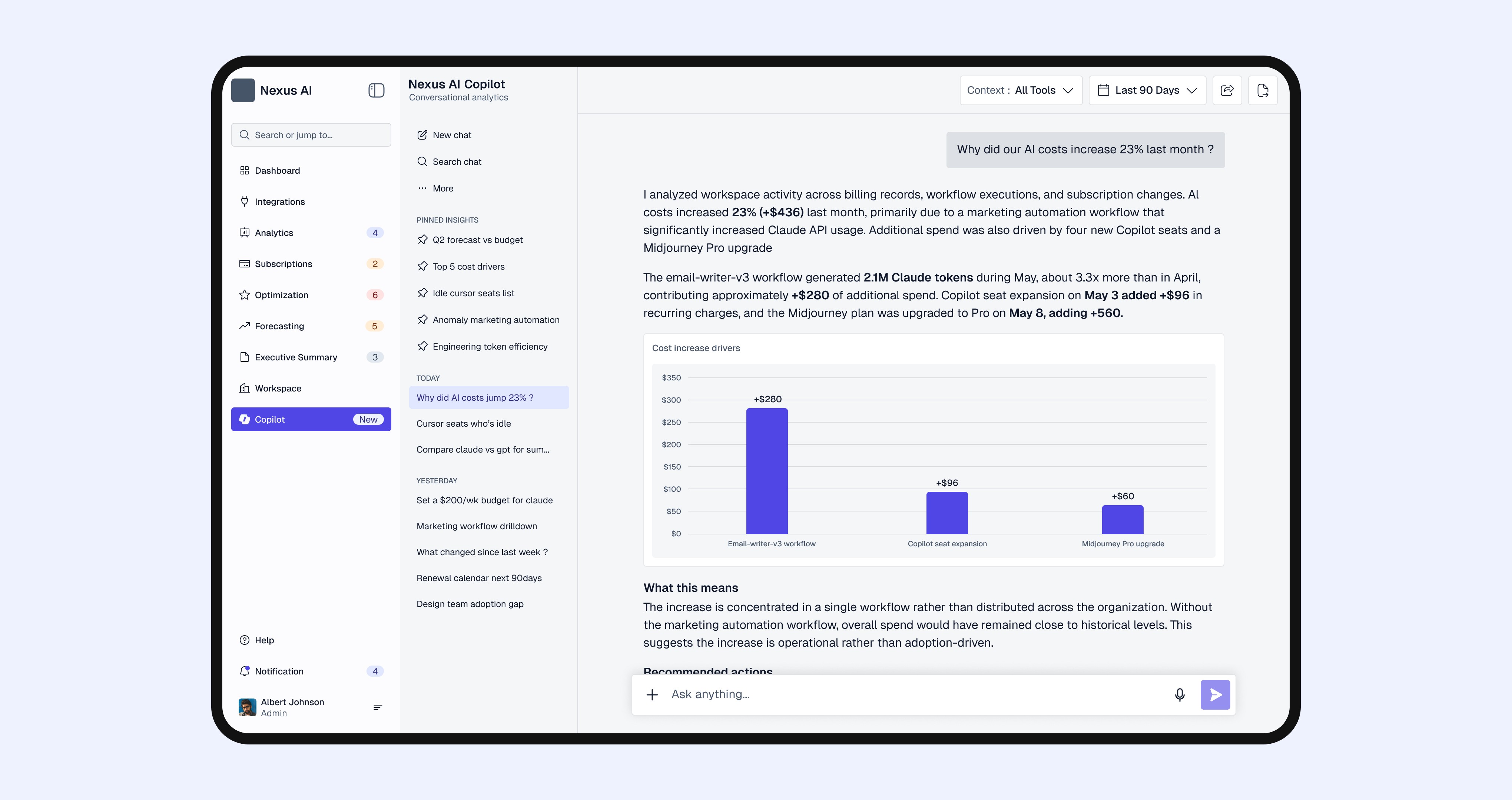
Enabling stakeholders to ask business questions in natural language and receive actionable insights without navigating multiple analytics views
As the platform accumulated data across integrations, analytics, subscriptions, and optimization workflows, extracting insights still required moving between multiple screens. The AI Copilot was introduced as a conversational layer that transforms complex operational data into clear explanations, helping users understand cost changes, anomalies, adoption patterns, and optimization opportunities through simple questions.
Problem
Understanding why costs changed, which workflows caused anomalies, or where optimization opportunities existed required users to manually analyze multiple dashboards and datasets, creating delays in decision-making.
Solution
Designed a context-aware AI Copilot that connects data across the platform and provides conversational answers, visual evidence, root-cause explanations, and recommended actions from a single interface.
Rationale
Decision-makers often need answers rather than reports. Translating operational data into natural language explanations reduces analysis effort and makes insights accessible beyond technical users.
Impact
Accelerates investigation workflows, improves accessibility of platform intelligence, reduces dependency on manual analysis, and helps teams move from identifying issues to taking action significantly faster.
Overall Impact
Tool Overlap
Less spending on multiple tools that serve the same purpose.
Cost Awareness
Consultation Pace
Clear visibility into where AI budgets are being used.
Unused Licenses
Operational Gaps
Reduced waste from inactive seats and underutilized subscriptions.
Faster Decisions
Quick access to insights without reviewing multiple reports.
Manual Tracking
Less effort spent monitoring tools, costs, and renewals manually.
Planning Confidence
Decision Clarity
Better budgeting and forecasting with connected operational data.
More Works
(GQ® — 02)
©2024

From scattered AI tools to a unified AI operations platform
AI Operations
SaaS B2B
Overview
AI subscriptions, token usage, and adoption data were spread across multiple tools, making it difficult to track costs, identify inefficiencies, and forecast spend. This case study unifies governance, optimization, and financial oversight into a single platform for smarter AI management.
Spend Waste
Reduced unnecessary subscription and token expenditure.
Visibility Gaps
Eliminated fragmented AI usage and spend tracking.
Cost Governance
Centralized monitoring of budgets, forecasts, and usage.
Optimization Insights
Actionable recommendations to improve efficiency and adoption.
Role
End to end product design
Tools
Contributors
Problem
AI adoption accelerates when teams move fast, but governance struggles when spend, usage, and ownership become fragmented
As AI tools became embedded across teams, organizations gained productivity but lost visibility into how those investments were being used. Subscription costs, token consumption, and adoption data were spread across multiple platforms, making it difficult to track spend, identify inefficiencies, and understand ownership. Without a centralized system, finance and operations teams relied on fragmented reports and manual reviews, limiting their ability to forecast costs, control budgets, and make confident decisions about AI investments.
Research & Discovery
Conversations with team managers revealed that AI adoption was growing faster than the organization’s ability to govern cost, utilization, and business value
01
AI spending grows quietly across teams
New AI tools are often introduced by individual teams to solve immediate productivity challenges. Over time, subscriptions accumulate across departments, creating a growing layer of spend that expands without a clear understanding of ownership, necessity, or overall business impact.
02
Cost visibility exists, value visibility does not
Managers can usually see invoices, subscription counts, and token usage. What remains difficult is understanding whether those costs translate into meaningful outcomes. As a result, renewal and budgeting decisions are often based on assumptions rather than measurable value.
03
Optimization becomes reactive instead of continuous
Without a unified view of adoption, utilization, and spend, opportunities to reduce waste are often discovered only during budget reviews or renewal cycles. By the time inefficiencies are identified, organizations may have already spent months paying for underutilized or overlapping tools.
Course of Action
Translating fragmented AI governance challenges into a structured system for visibility, optimization, and decision-making
The research revealed that organizations struggled not because AI adoption was low, but because visibility, ownership, and value were difficult to measure across an expanding ecosystem of tools. Based on these findings, I focused on defining the information architecture, workflows, and decision-support capabilities needed to help teams understand AI spend, identify inefficiencies, and optimize investments proactively.
01
Established a unified source of truth for AI operations
Consolidated spend, subscriptions, token usage, adoption, and governance insights into a single platform, eliminating the need to navigate multiple vendor dashboards and disconnected reports.
02
Structured the platform around key decision-making workflows
Defined information architecture and user flows around the questions finance, operations, and IT teams need answered most often: where money is spent, what creates value, and where optimization opportunities exist.
03
Prioritized actionable insights over raw reporting
Focused on surfacing meaningful recommendations such as duplicate tools, underutilized subscriptions, adoption gaps, and budget risks instead of overwhelming users with isolated usage metrics.
04
Used AI-assisted exploration to accelerate concept validation
Leveraged AI as a research and design partner to synthesize findings, evaluate solution directions, generate early workflow explorations, and rapidly iterate on wireframe concepts before moving into detailed design.
System Design
User Flow
The system was designed around the lifecycle of AI cost optimization, guiding users from identifying anomalies to understanding root causes and taking corrective action. Rather than separating analytics, subscriptions, and recommendations into disconnected experiences, the flow creates a continuous decision-making journey that helps teams uncover inefficiencies, validate opportunities, and capture measurable savings.
Information Architecture
The platform architecture was designed to transform fragmented AI management activities into a cohesive operational system. Core areas such as analytics, subscriptions, optimization, forecasting, workspace governance, and AI-assisted insights were structured around real user workflows rather than organizational silos. By grouping related decisions and actions together, the architecture reduces navigation complexity, improves discoverability, and enables users to move from understanding AI spend to taking optimization actions within a unified experience.
Initial Ideas
Exploring how complex AI governance workflows translate into usable interfaces
With the information architecture and core workflows established, I created multiple wireframe explorations to evaluate how analytics, subscriptions, forecasting, optimization, and AI-assisted insights should be organized across the product. These iterations focused on balancing high information density with usability, refining content hierarchy, validating navigation patterns, and ensuring users could quickly identify risks, investigate spend drivers, and act on recommendations without becoming overwhelmed by data.
Design System
Creating a design system that supports complex analytics while keeping enterprise workflows easy to scan and understand
As the platform expanded across analytics, forecasting, subscriptions, governance, and AI-assisted workflows, maintaining consistency became critical. The design system was built to standardize visual patterns, interaction behaviors, and data presentation across the product. Particular attention was given to readability, semantic feedback, and accessibility, ensuring complex information remains easy to interpret while adhering to WCAG 2.1 AA standards.
Design Principles
Prioritized information hierarchy to help users quickly identify critical insights within data-dense interfaces.
Used consistent spacing, typography, and component patterns to reduce cognitive load across workflows.
Applied semantic color usage to clearly communicate system states, risks, recommendations, and outcomes.
System Consistency & States
A unified foundation was established for colors, typography, component states, and interaction patterns to create a predictable experience across the platform. Accessibility was considered throughout the system, with contrast ratios, visual states, and typography designed to meet WCAG 2.1 AA guidelines while supporting clarity across analytics-heavy screens.
Dashboard
Surfacing anomalies, waste, and optimization opportunities before they become costly decisions
This dashboard was designed to help teams understand the operational health of their AI ecosystem at a glance. Rather than reviewing individual vendor portals, users can immediately see unusual spend activity, underutilized subscriptions, upcoming renewals, and optimization opportunities from a single workspace. The focus was on reducing investigation time and bringing attention to the signals that require action first.
Problem
AI costs often increase gradually through token spikes, duplicate tools, inactive seats, and overlooked renewals. Because this information lives across multiple platforms, teams typically discover inefficiencies only after budgets are exceeded or renewals are processed.
Solution
The dashboard proactively surfaces anomalies, utilization risks, renewal alerts, and AI-generated recommendations alongside spend and adoption metrics. This allows users to identify issues early and move directly into investigation or optimization workflows.
Rationale
Most operational decisions begin with identifying what changed. By prioritizing anomalies, health indicators, and actionable recommendations above detailed analytics, users can quickly understand where attention is needed without manually searching through reports.
Impact
Reduces the time required to detect cost inefficiencies, improves visibility into ecosystem health, and helps teams take corrective action before waste accumulates or unnecessary spending continues across the organization.
Integrations
Creating a centralized layer to connect, monitor, and govern AI tools across the organization
The Integrations experience was designed to solve one of the biggest challenges in AI governance: fragmented visibility. As organizations adopt multiple AI products across departments, understanding usage, cost, permissions, and operational health becomes increasingly difficult. This section allows teams to connect AI tools into a single ecosystem and continuously monitor their performance, utilization, and business impact.
Problem
AI adoption often happens independently across teams, resulting in disconnected tools, scattered usage data, and limited oversight. Without a centralized integration layer, organizations struggle to understand how tools are being used, who owns them, and whether they continue to deliver value.
Solution
The integration library provides a structured catalog for discovering and connecting AI tools, while dedicated tool-level views surface usage trends, token consumption, costs, permissions, and operational health. This creates a single source of truth for managing AI services across the organization.
Rationale
Connecting a tool is only the beginning of governance. Users also need ongoing visibility into how that tool performs after adoption. By combining integration management with operational monitoring, the experience supports both onboarding and long-term optimization within the same workflow.
Impact
Improves visibility across the AI ecosystem, reduces dependency on individual vendor dashboards, and enables teams to monitor utilization, identify inefficiencies, and make more informed decisions about tool adoption and ongoing investment.
Analytics
Creating a structured analytics layer to understand AI spend, usage patterns, and optimization opportunities
As AI adoption grows, understanding where costs originate and how tools are being utilized becomes increasingly difficult. The analytics experience was designed to consolidate token usage, spend, efficiency metrics, tool comparisons, and anomalies into a single workspace. The focus was on helping teams move from observing metrics to identifying waste, understanding drivers, and making informed optimization decisions.
Problem
AI usage and cost data are often distributed across multiple vendor platforms. This makes it difficult to understand which tools drive spend, identify inefficiencies, compare performance, or detect unusual activity before it impacts budgets.
Solution
Designed dedicated analytics views for token consumption, cost breakdowns, tool comparisons, and anomaly detection, allowing users to investigate AI activity from ecosystem-level trends down to individual tool performance.
Rationale
Operational and financial decisions require more than reporting metrics. Structuring analytics around investigation workflows helps users move from identifying issues to understanding root causes and evaluating optimization opportunities.
Impact
Provides greater visibility into AI investments, surfaces inefficient usage patterns, highlights anomalies earlier, and enables teams to make data-driven decisions around spend, adoption, and tool effectiveness.
Subscription Management
& Renewal Decisions
Helping teams make renewal decisions based on utilization, value, and actual usage
As AI adoption increases, subscriptions often renew automatically without a clear understanding of utilization or business impact. This experience was designed to surface renewal risks early, combining usage patterns, activity history, overlap detection, and AI-driven recommendations into a single decision-making workflow. The goal was to replace reactive subscription management with proactive optimization and cost control.
Problem
Organizations frequently renew AI subscriptions without visibility into adoption, utilization, or overlapping capabilities. Teams struggle to determine whether a tool should be renewed, downgraded, consolidated, or removed before renewal deadlines occur.
Solution
Designed a renewal workspace that combines utilization analytics, renewal timelines, audit history, and AI-generated recommendations, enabling users to evaluate subscription value and take action directly from the decision flow.
Rationale
Renewal decisions are financial decisions. Presenting usage evidence, cost implications, activity patterns, and alternative options together reduces uncertainty and helps users justify optimization actions with confidence.
Impact
Improves subscription governance, reduces unnecessary renewals, surfaces underutilized tools before renewal dates, and enables organizations to capture savings opportunities without disrupting active workflows or teams.
Optimization Engine
Turning AI usage insights into actionable recommendations that reduce waste and improve efficiency
Collecting usage data alone does not help organizations optimize AI investments. The optimization experience was designed to convert analytics into clear, evidence-backed recommendations that identify underutilized tools, overlapping subscriptions, and cost-saving opportunities. The focus was on helping teams confidently act on optimization opportunities rather than manually interpreting large volumes of operational data.
Problem
Organizations often recognize inefficiencies only after costs have accumulated. Identifying underutilized tools, duplicate subscriptions, and optimization opportunities typically requires manual analysis across multiple reports and disconnected systems.
Solution
Designed an AI-powered recommendation layer that continuously evaluates utilization, adoption trends, overlap signals, and renewal risks to generate prioritized optimization actions with projected savings and confidence scores.
Rationale
Optimization decisions require trust. Presenting supporting evidence, usage trends, projected impact, and affected workflows alongside each recommendation helps users understand why an action is suggested before taking action.
Impact
Reduces manual analysis effort, surfaces cost-saving opportunities earlier, improves subscription efficiency, and enables organizations to capture measurable savings through proactive optimization rather than reactive cost management.
Forecasting & Budget Planning
Enabling teams to anticipate future AI spend and prevent budget overruns before they occur
Managing AI costs becomes increasingly difficult when decisions are based only on historical data. The forecasting experience was designed to help teams understand future spending trajectories, renewal exposure, and budget risks before they impact operations. The focus was on shifting cost management from reactive reporting to proactive planning through predictive insights and scenario-based decision making.
Problem
Organizations often discover budget overruns after costs have already accumulated. Without forecasting capabilities, teams struggle to anticipate spend growth, renewal impacts, and future financial risks across their AI ecosystem.
Solution
Designed a forecasting workspace that combines spend projections, confidence intervals, budget thresholds, renewal risk indicators, and future growth trends to support planning and budget allocation decisions.
Rationale
Financial planning requires visibility into what is likely to happen, not just what has happened. Presenting projected spend alongside budget limits and risk signals enables users to identify potential issues early and adjust accordingly.
Impact
Improves budget predictability, surfaces future cost risks before they occur, supports more accurate planning decisions, and helps organizations maintain control over AI spending as adoption scales across teams.
Executive Summary
Converting complex AI usage data into executive-ready insights and recommended actions
Stakeholders often need clear answers without navigating detailed analytics dashboards. The Executive Summary experience was designed to transform operational data into concise narratives that highlight spending trends, key changes, optimization opportunities, and business risks. The focus was on helping decision-makers quickly understand what happened, why it happened, and what actions should be prioritized next.
Problem
AI spending, adoption, and optimization data are distributed across multiple workflows and reports. Executives often lack a simple way to understand ecosystem performance, emerging risks, and high-impact decisions without reviewing detailed analytics.
Solution
Designed an AI-generated reporting experience that consolidates ecosystem health, spending trends, anomalies, renewals, and optimization opportunities into a structured executive briefing with actionable recommendations.
Rationale
Leadership teams require insights rather than raw metrics. Presenting key changes, cost drivers, business impacts, and recommended actions together enables faster understanding and more informed decision-making.
Impact
Reduces reporting effort, improves visibility into AI investments, aligns stakeholders around key priorities, and helps organizations make strategic decisions using a consistent view of ecosystem performance and optimization opportunities.
Workspace Management
Providing visibility into team-level AI adoption while maintaining governance, access control, and operational accountability
As AI usage expanded across departments, organizations needed a way to understand how tools were being adopted, where spending was concentrated, and who had access to critical systems. The Workspace module was designed to combine departmental insights with centralized user management, enabling teams to monitor adoption patterns, identify inefficiencies, and maintain control over permissions at scale.
Problem
AI adoption often grows unevenly across departments, making it difficult to track usage patterns, identify overlapping tools, and manage user access. Teams lacked a centralized view of organizational adoption and governance.
Solution
Created a workspace management experience that combines department-level analytics, adoption monitoring, duplicate tool detection, and role-based access management within a single operational environment.
Rationale
Understanding usage at both team and individual levels helps organizations balance adoption, spending, and governance. Centralizing these controls reduces administrative overhead while improving visibility across the ecosystem.
Impact
Enables better resource allocation, improves oversight of AI adoption across departments, strengthens access governance, and helps organizations scale AI usage with greater operational control and accountability.
AI Copilot
Enabling stakeholders to ask business questions in natural language and receive actionable insights without navigating multiple analytics views
As the platform accumulated data across integrations, analytics, subscriptions, and optimization workflows, extracting insights still required moving between multiple screens. The AI Copilot was introduced as a conversational layer that transforms complex operational data into clear explanations, helping users understand cost changes, anomalies, adoption patterns, and optimization opportunities through simple questions.
Problem
Understanding why costs changed, which workflows caused anomalies, or where optimization opportunities existed required users to manually analyze multiple dashboards and datasets, creating delays in decision-making.
Solution
Designed a context-aware AI Copilot that connects data across the platform and provides conversational answers, visual evidence, root-cause explanations, and recommended actions from a single interface.
Rationale
Decision-makers often need answers rather than reports. Translating operational data into natural language explanations reduces analysis effort and makes insights accessible beyond technical users.
Impact
Accelerates investigation workflows, improves accessibility of platform intelligence, reduces dependency on manual analysis, and helps teams move from identifying issues to taking action significantly faster.
Overall Impact
Tool Overlap
Less spending on multiple tools that serve the same purpose.
Cost Awareness
Consultation Pace
Clear visibility into where AI budgets are being used.
Unused Licenses
Operational Gaps
Reduced waste from inactive seats and underutilized subscriptions.
Faster Decisions
Quick access to insights without reviewing multiple reports.
Manual Tracking
Less effort spent monitoring tools, costs, and renewals manually.
Planning Confidence
Decision Clarity
Better budgeting and forecasting with connected operational data.
More Works
(GQ® — 02)
©2024
From scattered AI tools to a unified AI operations platform
AI Operations
SaaS B2B
Overview
AI subscriptions, token usage, and adoption data were spread across multiple tools, making it difficult to track costs, identify inefficiencies, and forecast spend. This case study unifies governance, optimization, and financial oversight into a single platform for smarter AI management.
Spend Waste
Reduced unnecessary subscription and token expenditure.
Visibility Gaps
Eliminated fragmented AI usage and spend tracking.
Cost Governance
Centralized monitoring of budgets, forecasts, and usage.
Optimization Insights
Actionable recommendations to improve efficiency and adoption.
Role
End to end product design
Tools
Contributors
Problem
AI adoption accelerates when teams move fast, but governance struggles when spend, usage, and ownership become fragmented
As AI tools became embedded across teams, organizations gained productivity but lost visibility into how those investments were being used. Subscription costs, token consumption, and adoption data were spread across multiple platforms, making it difficult to track spend, identify inefficiencies, and understand ownership. Without a centralized system, finance and operations teams relied on fragmented reports and manual reviews, limiting their ability to forecast costs, control budgets, and make confident decisions about AI investments.
Research & Discovery
Conversations with team managers revealed that AI adoption was growing faster than the organization’s ability to govern cost, utilization, and business value
01
AI spending grows quietly across teams
New AI tools are often introduced by individual teams to solve immediate productivity challenges. Over time, subscriptions accumulate across departments, creating a growing layer of spend that expands without a clear understanding of ownership, necessity, or overall business impact.
02
Cost visibility exists, value visibility does not
Managers can usually see invoices, subscription counts, and token usage. What remains difficult is understanding whether those costs translate into meaningful outcomes. As a result, renewal and budgeting decisions are often based on assumptions rather than measurable value.
03
Optimization becomes reactive instead of continuous
Without a unified view of adoption, utilization, and spend, opportunities to reduce waste are often discovered only during budget reviews or renewal cycles. By the time inefficiencies are identified, organizations may have already spent months paying for underutilized or overlapping tools.
Course of Action
Translating fragmented AI governance challenges into a structured system for visibility, optimization, and decision-making
The research revealed that organizations struggled not because AI adoption was low, but because visibility, ownership, and value were difficult to measure across an expanding ecosystem of tools. Based on these findings, I focused on defining the information architecture, workflows, and decision-support capabilities needed to help teams understand AI spend, identify inefficiencies, and optimize investments proactively.
01
Established a unified source of truth for AI operations
Consolidated spend, subscriptions, token usage, adoption, and governance insights into a single platform, eliminating the need to navigate multiple vendor dashboards and disconnected reports.
02
Structured the platform around key decision-making workflows
Defined information architecture and user flows around the questions finance, operations, and IT teams need answered most often: where money is spent, what creates value, and where optimization opportunities exist.
03
Prioritized actionable insights over raw reporting
Focused on surfacing meaningful recommendations such as duplicate tools, underutilized subscriptions, adoption gaps, and budget risks instead of overwhelming users with isolated usage metrics.
04
Used AI-assisted exploration to accelerate concept validation
Leveraged AI as a research and design partner to synthesize findings, evaluate solution directions, generate early workflow explorations, and rapidly iterate on wireframe concepts before moving into detailed design.
System Design
User Flow
The system was designed around the lifecycle of AI cost optimization, guiding users from identifying anomalies to understanding root causes and taking corrective action. Rather than separating analytics, subscriptions, and recommendations into disconnected experiences, the flow creates a continuous decision-making journey that helps teams uncover inefficiencies, validate opportunities, and capture measurable savings.
Information Architecture
The platform architecture was designed to transform fragmented AI management activities into a cohesive operational system. Core areas such as analytics, subscriptions, optimization, forecasting, workspace governance, and AI-assisted insights were structured around real user workflows rather than organizational silos. By grouping related decisions and actions together, the architecture reduces navigation complexity, improves discoverability, and enables users to move from understanding AI spend to taking optimization actions within a unified experience.
Initial Ideas
Exploring how complex AI governance workflows translate into usable interfaces
With the information architecture and core workflows established, I created multiple wireframe explorations to evaluate how analytics, subscriptions, forecasting, optimization, and AI-assisted insights should be organized across the product. These iterations focused on balancing high information density with usability, refining content hierarchy, validating navigation patterns, and ensuring users could quickly identify risks, investigate spend drivers, and act on recommendations without becoming overwhelmed by data.
Design System
Creating a design system that supports complex analytics while keeping enterprise workflows easy to scan and understand
As the platform expanded across analytics, forecasting, subscriptions, governance, and AI-assisted workflows, maintaining consistency became critical. The design system was built to standardize visual patterns, interaction behaviors, and data presentation across the product. Particular attention was given to readability, semantic feedback, and accessibility, ensuring complex information remains easy to interpret while adhering to WCAG 2.1 AA standards.
Design Principles
Prioritized information hierarchy to help users quickly identify critical insights within data-dense interfaces.
Used consistent spacing, typography, and component patterns to reduce cognitive load across workflows.
Applied semantic color usage to clearly communicate system states, risks, recommendations, and outcomes.
System Consistency & States
A unified foundation was established for colors, typography, component states, and interaction patterns to create a predictable experience across the platform. Accessibility was considered throughout the system, with contrast ratios, visual states, and typography designed to meet WCAG 2.1 AA guidelines while supporting clarity across analytics-heavy screens.
Dashboard
Surfacing anomalies, waste, and optimization opportunities before they become costly decisions
This dashboard was designed to help teams understand the operational health of their AI ecosystem at a glance. Rather than reviewing individual vendor portals, users can immediately see unusual spend activity, underutilized subscriptions, upcoming renewals, and optimization opportunities from a single workspace. The focus was on reducing investigation time and bringing attention to the signals that require action first.
Problem
AI costs often increase gradually through token spikes, duplicate tools, inactive seats, and overlooked renewals. Because this information lives across multiple platforms, teams typically discover inefficiencies only after budgets are exceeded or renewals are processed.
Solution
The dashboard proactively surfaces anomalies, utilization risks, renewal alerts, and AI-generated recommendations alongside spend and adoption metrics. This allows users to identify issues early and move directly into investigation or optimization workflows.
Rationale
Most operational decisions begin with identifying what changed. By prioritizing anomalies, health indicators, and actionable recommendations above detailed analytics, users can quickly understand where attention is needed without manually searching through reports.
Impact
Reduces the time required to detect cost inefficiencies, improves visibility into ecosystem health, and helps teams take corrective action before waste accumulates or unnecessary spending continues across the organization.
Integrations
Creating a centralized layer to connect, monitor, and govern AI tools across the organization
The Integrations experience was designed to solve one of the biggest challenges in AI governance: fragmented visibility. As organizations adopt multiple AI products across departments, understanding usage, cost, permissions, and operational health becomes increasingly difficult. This section allows teams to connect AI tools into a single ecosystem and continuously monitor their performance, utilization, and business impact.
Problem
AI adoption often happens independently across teams, resulting in disconnected tools, scattered usage data, and limited oversight. Without a centralized integration layer, organizations struggle to understand how tools are being used, who owns them, and whether they continue to deliver value.
Solution
The integration library provides a structured catalog for discovering and connecting AI tools, while dedicated tool-level views surface usage trends, token consumption, costs, permissions, and operational health. This creates a single source of truth for managing AI services across the organization.
Rationale
Connecting a tool is only the beginning of governance. Users also need ongoing visibility into how that tool performs after adoption. By combining integration management with operational monitoring, the experience supports both onboarding and long-term optimization within the same workflow.
Impact
Improves visibility across the AI ecosystem, reduces dependency on individual vendor dashboards, and enables teams to monitor utilization, identify inefficiencies, and make more informed decisions about tool adoption and ongoing investment.
Analytics
Creating a structured analytics layer to understand AI spend, usage patterns, and optimization opportunities
As AI adoption grows, understanding where costs originate and how tools are being utilized becomes increasingly difficult. The analytics experience was designed to consolidate token usage, spend, efficiency metrics, tool comparisons, and anomalies into a single workspace. The focus was on helping teams move from observing metrics to identifying waste, understanding drivers, and making informed optimization decisions.
Problem
AI usage and cost data are often distributed across multiple vendor platforms. This makes it difficult to understand which tools drive spend, identify inefficiencies, compare performance, or detect unusual activity before it impacts budgets.
Solution
Designed dedicated analytics views for token consumption, cost breakdowns, tool comparisons, and anomaly detection, allowing users to investigate AI activity from ecosystem-level trends down to individual tool performance.
Rationale
Operational and financial decisions require more than reporting metrics. Structuring analytics around investigation workflows helps users move from identifying issues to understanding root causes and evaluating optimization opportunities.
Impact
Provides greater visibility into AI investments, surfaces inefficient usage patterns, highlights anomalies earlier, and enables teams to make data-driven decisions around spend, adoption, and tool effectiveness.
Subscription Management
& Renewal Decisions
Helping teams make renewal decisions based on utilization, value, and actual usage
As AI adoption increases, subscriptions often renew automatically without a clear understanding of utilization or business impact. This experience was designed to surface renewal risks early, combining usage patterns, activity history, overlap detection, and AI-driven recommendations into a single decision-making workflow. The goal was to replace reactive subscription management with proactive optimization and cost control.
Problem
Organizations frequently renew AI subscriptions without visibility into adoption, utilization, or overlapping capabilities. Teams struggle to determine whether a tool should be renewed, downgraded, consolidated, or removed before renewal deadlines occur.
Solution
Designed a renewal workspace that combines utilization analytics, renewal timelines, audit history, and AI-generated recommendations, enabling users to evaluate subscription value and take action directly from the decision flow.
Rationale
Renewal decisions are financial decisions. Presenting usage evidence, cost implications, activity patterns, and alternative options together reduces uncertainty and helps users justify optimization actions with confidence.
Impact
Improves subscription governance, reduces unnecessary renewals, surfaces underutilized tools before renewal dates, and enables organizations to capture savings opportunities without disrupting active workflows or teams.
Optimization Engine
Turning AI usage insights into actionable recommendations that reduce waste and improve efficiency
Collecting usage data alone does not help organizations optimize AI investments. The optimization experience was designed to convert analytics into clear, evidence-backed recommendations that identify underutilized tools, overlapping subscriptions, and cost-saving opportunities. The focus was on helping teams confidently act on optimization opportunities rather than manually interpreting large volumes of operational data.
Problem
Organizations often recognize inefficiencies only after costs have accumulated. Identifying underutilized tools, duplicate subscriptions, and optimization opportunities typically requires manual analysis across multiple reports and disconnected systems.
Solution
Designed an AI-powered recommendation layer that continuously evaluates utilization, adoption trends, overlap signals, and renewal risks to generate prioritized optimization actions with projected savings and confidence scores.
Rationale
Optimization decisions require trust. Presenting supporting evidence, usage trends, projected impact, and affected workflows alongside each recommendation helps users understand why an action is suggested before taking action.
Impact
Reduces manual analysis effort, surfaces cost-saving opportunities earlier, improves subscription efficiency, and enables organizations to capture measurable savings through proactive optimization rather than reactive cost management.
Forecasting & Budget Planning
Enabling teams to anticipate future AI spend and prevent budget overruns before they occur
Managing AI costs becomes increasingly difficult when decisions are based only on historical data. The forecasting experience was designed to help teams understand future spending trajectories, renewal exposure, and budget risks before they impact operations. The focus was on shifting cost management from reactive reporting to proactive planning through predictive insights and scenario-based decision making.
Problem
Organizations often discover budget overruns after costs have already accumulated. Without forecasting capabilities, teams struggle to anticipate spend growth, renewal impacts, and future financial risks across their AI ecosystem.
Solution
Designed a forecasting workspace that combines spend projections, confidence intervals, budget thresholds, renewal risk indicators, and future growth trends to support planning and budget allocation decisions.
Rationale
Financial planning requires visibility into what is likely to happen, not just what has happened. Presenting projected spend alongside budget limits and risk signals enables users to identify potential issues early and adjust accordingly.
Impact
Improves budget predictability, surfaces future cost risks before they occur, supports more accurate planning decisions, and helps organizations maintain control over AI spending as adoption scales across teams.
Executive Summary
Converting complex AI usage data into executive-ready insights and recommended actions
Stakeholders often need clear answers without navigating detailed analytics dashboards. The Executive Summary experience was designed to transform operational data into concise narratives that highlight spending trends, key changes, optimization opportunities, and business risks. The focus was on helping decision-makers quickly understand what happened, why it happened, and what actions should be prioritized next.
Problem
AI spending, adoption, and optimization data are distributed across multiple workflows and reports. Executives often lack a simple way to understand ecosystem performance, emerging risks, and high-impact decisions without reviewing detailed analytics.
Solution
Designed an AI-generated reporting experience that consolidates ecosystem health, spending trends, anomalies, renewals, and optimization opportunities into a structured executive briefing with actionable recommendations.
Rationale
Leadership teams require insights rather than raw metrics. Presenting key changes, cost drivers, business impacts, and recommended actions together enables faster understanding and more informed decision-making.
Impact
Reduces reporting effort, improves visibility into AI investments, aligns stakeholders around key priorities, and helps organizations make strategic decisions using a consistent view of ecosystem performance and optimization opportunities.
Workspace Management
Providing visibility into team-level AI adoption while maintaining governance, access control, and operational accountability
As AI usage expanded across departments, organizations needed a way to understand how tools were being adopted, where spending was concentrated, and who had access to critical systems. The Workspace module was designed to combine departmental insights with centralized user management, enabling teams to monitor adoption patterns, identify inefficiencies, and maintain control over permissions at scale.
Problem
AI adoption often grows unevenly across departments, making it difficult to track usage patterns, identify overlapping tools, and manage user access. Teams lacked a centralized view of organizational adoption and governance.
Solution
Created a workspace management experience that combines department-level analytics, adoption monitoring, duplicate tool detection, and role-based access management within a single operational environment.
Rationale
Understanding usage at both team and individual levels helps organizations balance adoption, spending, and governance. Centralizing these controls reduces administrative overhead while improving visibility across the ecosystem.
Impact
Enables better resource allocation, improves oversight of AI adoption across departments, strengthens access governance, and helps organizations scale AI usage with greater operational control and accountability.
AI Copilot
Enabling stakeholders to ask business questions in natural language and receive actionable insights without navigating multiple analytics views
As the platform accumulated data across integrations, analytics, subscriptions, and optimization workflows, extracting insights still required moving between multiple screens. The AI Copilot was introduced as a conversational layer that transforms complex operational data into clear explanations, helping users understand cost changes, anomalies, adoption patterns, and optimization opportunities through simple questions.
Problem
Understanding why costs changed, which workflows caused anomalies, or where optimization opportunities existed required users to manually analyze multiple dashboards and datasets, creating delays in decision-making.
Solution
Designed a context-aware AI Copilot that connects data across the platform and provides conversational answers, visual evidence, root-cause explanations, and recommended actions from a single interface.
Rationale
Decision-makers often need answers rather than reports. Translating operational data into natural language explanations reduces analysis effort and makes insights accessible beyond technical users.
Impact
Accelerates investigation workflows, improves accessibility of platform intelligence, reduces dependency on manual analysis, and helps teams move from identifying issues to taking action significantly faster.
Overall Impact
Tool Overlap
Less spending on multiple tools that serve the same purpose.
Cost Awareness
Consultation Pace
Clear visibility into where AI budgets are being used.
Unused Licenses
Operational Gaps
Reduced waste from inactive seats and underutilized subscriptions.
Faster Decisions
Quick access to insights without reviewing multiple reports.
Manual Tracking
Less effort spent monitoring tools, costs, and renewals manually.
Planning Confidence
Decision Clarity
Better budgeting and forecasting with connected operational data.
More Works
©2024