
Streamlining hiring and employee workflows
HR Tech
SaaS B2B
Overview
In the hiring workflows I analyzed, recruiters spent most of their time piecing together candidate progress across scattered systems and running interviews without consistent oversight or reliable evaluation signals. This case study restructures those workflows into a more connected, real-time hiring system.
Coordination Overhead
Less time spent piecing together candidate updates across stages
Evaluation
Reliability
Evaluation Reliability
Consistent, verifiable assessments replace subjective interview outcomes
Decision Clarity
Hiring decisions backed by structured data instead of scattered inputs
Role
End to End Product Design
Tools


Contributors

Problem
Looking into everyday hiring workflows revealed the real issue wasn’t the volume of candidates, but how evaluations and decisions were shaped by fragmented systems and unreliable signals.
In most teams, candidate tracking, interviews, and evaluations happen across disconnected systems, forcing recruiters to constantly piece together progress from multiple sources. Interviews are often conducted without consistent oversight, making it difficult to compare candidates fairly or trust evaluation outcomes. With limited visibility into candidate progression and performance, decisions are frequently based on incomplete context rather than clear signals. Over time, this leads to delays in hiring, inconsistent assessments, and increased dependency on manual coordination across teams.

System Design
User Flow
Hiring rarely moves in clean stages. It cycles through reviewing candidates, assigning assessments, revisiting feedback, and aligning on decisions. The flow supports this by keeping candidates, evaluations, and outcomes within a single connected path. As candidates move across stages, inputs like scores, notes, and reports stay attached to their progression, enabling decisions based on accumulated context. This reduces scattered inputs, prevents missed signals, and keeps candidate movement continuous instead of resetting at each stage.

Information Architecture
The system is divided into multiple modules, but this section focuses on job management, where most of the hiring work actually happens. Instead of splitting candidates, assessments, and interview feedback into separate sections, everything is structured around a single job and unfolds within that context. From creating a role to reviewing candidates and progressing them through the pipeline, each layer applications, assessments, interview outputs, and final decisions stays tied to the same flow. This avoids jumping across views to piece together information and ensures that every action, from shortlisting to offering, is supported by the full set of signals already gathered within the job.

Initial Ideas
Exploring layout directions to structure decision-heavy hiring workflows
With the flows defined, the focus moved to testing how much of the hiring process could realistically live within a single screen before it became hard to work with. Early directions either exposed too much at once making it difficult to scan or pushed key actions into separate views, breaking continuity. These explorations helped identify where the flow needed compression versus expansion, especially when handling candidate lists alongside evaluation inputs and next-step actions. Through these iterations, the layouts evolved to balance visibility and interaction, ensuring that critical context stayed accessible while reducing unnecessary shifts between views.

Design System
Designing a system that makes candidate signals, states, and decisions clear across workflows
As the product moved from fragmented workflows to a connected system, the visual layer needed to support how hiring decisions are actually made. The system was designed to surface candidate status, evaluation inputs, and next actions in a way that is immediately understandable within dense screens. Instead of relying on users to piece together context, each element is structured to communicate progression and feedback clearly, allowing users to move between reviewing candidates and making decisions without losing track of critical signals.
Design Principles
Prioritized visibility of candidate progression and evaluation signals, making it easier to track status and compare inputs
Structured layouts using consistent spacing and grouping to keep related actions, data, and outcomes within the same context
Defined typography scales, spacing systems, and accessible contrast following WCAG AA standards to ensure readability across dense interfaces
System Consistency & States
A unified system was established for colors, components, typography, and interaction states to ensure consistent interpretation across workflows. States such as candidate progression, feedback, and system responses are designed to clearly communicate changes at every stage. This ensures that users can rely on familiar patterns to understand what has changed, what requires action, and how to proceed, supporting smoother and more confident decision-making throughout the hiring process.

Job Dashboard
A centralized view to understand candidate movement across roles and respond to hiring gaps as they appear
The dashboard brings together all active roles with their stage-wise candidate distribution into a single, structured view. Instead of tracking candidates individually, it shows how candidates move through stages like application, assessment, and interviews within each role. This allows recruiters to quickly spot where progression slows, identify roles with imbalanced pipelines, and take action without switching between multiple views or manually piecing together updates.
Problem
Candidate progression is often scattered across roles and stages, making it difficult to understand where movement slows or where follow-ups are needed. Recruiters rely on manual tracking or multiple views, leading to delayed actions and missed signals in the hiring process.
Solution
A unified dashboard presents each role with its stage-wise candidate counts, making progression visible in one place. Recruiters can scan movement across stages, identify gaps, and act directly without navigating into separate pipeline views.
Rationale
Hiring progress depends on how candidates move across stages within each role. By exposing stage distribution alongside roles, the system makes progression patterns visible, helping recruiters quickly identify delays and prioritize actions.
Impact
Improves visibility into candidate movement, reduces time spent tracking progress, and enables faster responses to gaps, leading to more consistent and efficient hiring decisions.

Job Creation
A structured workspace to define roles, capture requirements, and set the foundation for candidate progression
The job creation flow brings together role details, requirements, and hiring setup into a guided workspace. Instead of scattered inputs, it organizes job definition, application structure, and hiring stages into a step-by-step flow. This ensures that every role is created with the necessary context description, skills, and process so candidate evaluation and progression remain consistent from the start without requiring adjustments later.
Problem
Job setup is often fragmented across multiple inputs, leading to incomplete role definitions and inconsistent hiring criteria. This creates gaps in how candidates are evaluated and requires repeated corrections during later stages.
Solution
A structured creation flow guides recruiters through defining role details, application requirements, and hiring stages in one place. This ensures that all necessary inputs are captured upfront and aligned with how candidates will be evaluated.
Rationale
Hiring outcomes depend on how clearly roles and evaluation criteria are defined at the beginning. By structuring job creation as a guided flow, the system reduces ambiguity and ensures consistency in downstream candidate assessment.
Impact
Improves consistency in role definition, reduces rework during hiring stages, and ensures smoother candidate progression by establishing a clear foundation from the start.

Hiring Stage Creation
A structured flow to define hiring stages, align evaluation steps, and control how candidates progress
The hiring stage setup allows recruiters to define how candidates move through the hiring process by structuring stages in a clear, ordered flow. Instead of relying on loosely defined steps, it provides a visual way to configure stages like screening, interviews, and final decisions. This ensures that candidate progression follows a consistent path, making it easier to track movement, assign evaluations, and maintain alignment across roles without redefining the process each time.
Problem
Hiring stages are often loosely defined or vary across roles, leading to inconsistent candidate progression and unclear evaluation steps. This makes it difficult to track movement, compare candidates, and maintain alignment in decision-making.
Solution
A configurable stage setup enables recruiters to define, reorder, and structure hiring stages within a single flow. This ensures that each role follows a clear progression path, making candidate movement and evaluation steps consistent and easy to manage.
Rationale
Candidate evaluation depends on how clearly stages are defined and followed. By structuring stages as a visual flow, the system creates a shared framework for progression, reducing ambiguity and improving consistency across hiring processes.
Impact
Improves consistency in candidate progression, simplifies stage management, and enables clearer tracking of hiring flow, leading to more structured and reliable decision-making.

Applied Candidates
A focused view to review, compare, and act on candidates within a specific stage
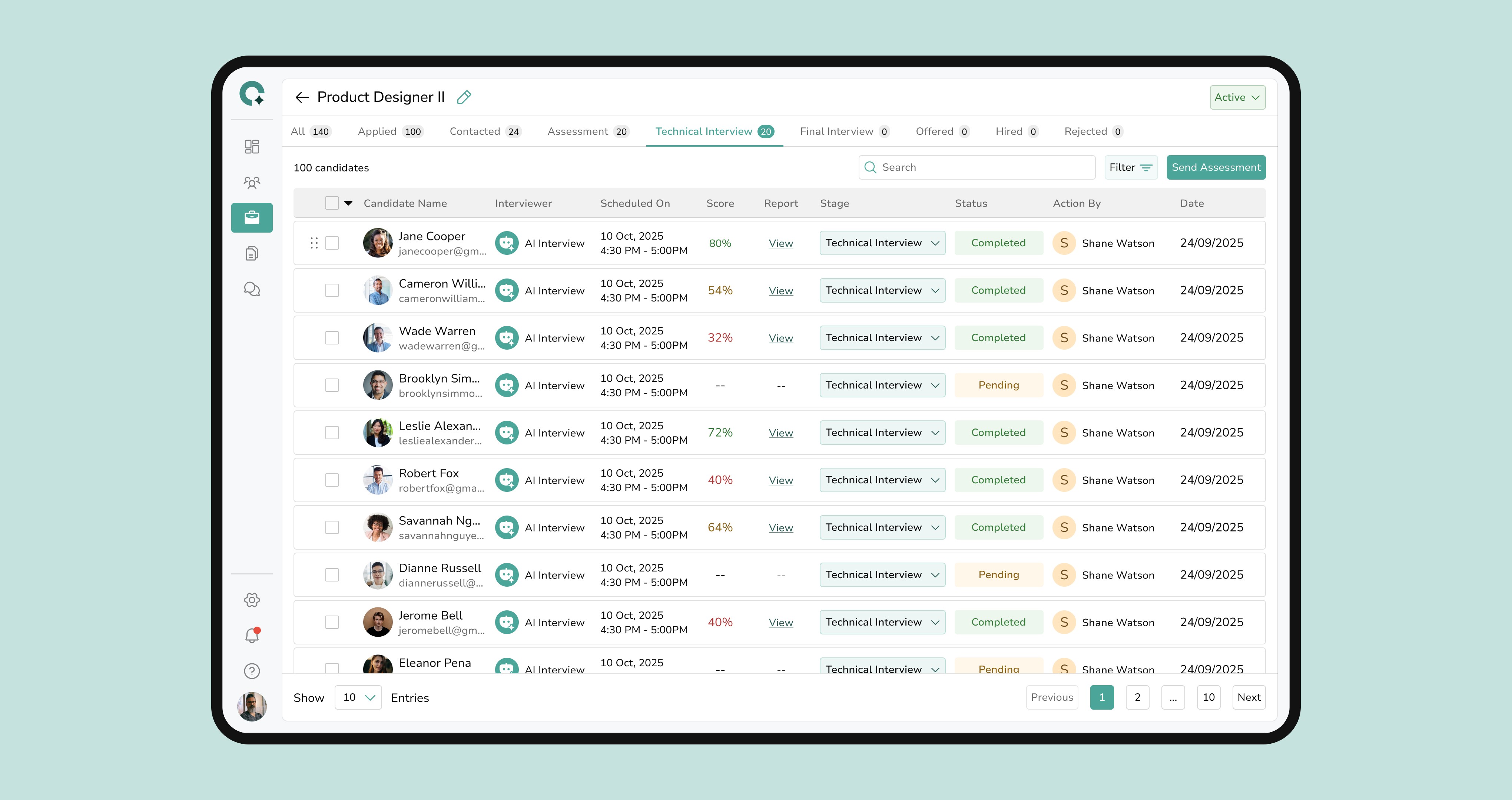
The applied candidates view brings all incoming candidates into a structured list where key signals experience, skills, ratings, and source are visible in one place. Instead of reviewing profiles individually, recruiters can scan and compare candidates side by side, quickly identifying who meets the role requirements. This allows faster shortlisting and movement to the next stage without repeatedly opening detailed views or losing context.
Problem
Candidate evaluation often requires opening multiple profiles or switching between views, making it difficult to compare candidates efficiently. This slows down shortlisting and increases the chances of missing strong candidates.
Solution
A unified list presents candidates with their key attributes and evaluation signals, allowing recruiters to scan, compare, and take action directly within the same view. This reduces the need for repeated navigation and speeds up decision-making.
Rationale
Shortlisting depends on quick comparison across multiple candidates. By surfacing relevant signals within a single structured view, the system reduces effort and helps recruiters make more consistent evaluation decisions.
Impact
Speeds up candidate shortlisting, improves comparison across applicants, and reduces time spent navigating between profiles, leading to faster and more efficient hiring decisions.
Assessment
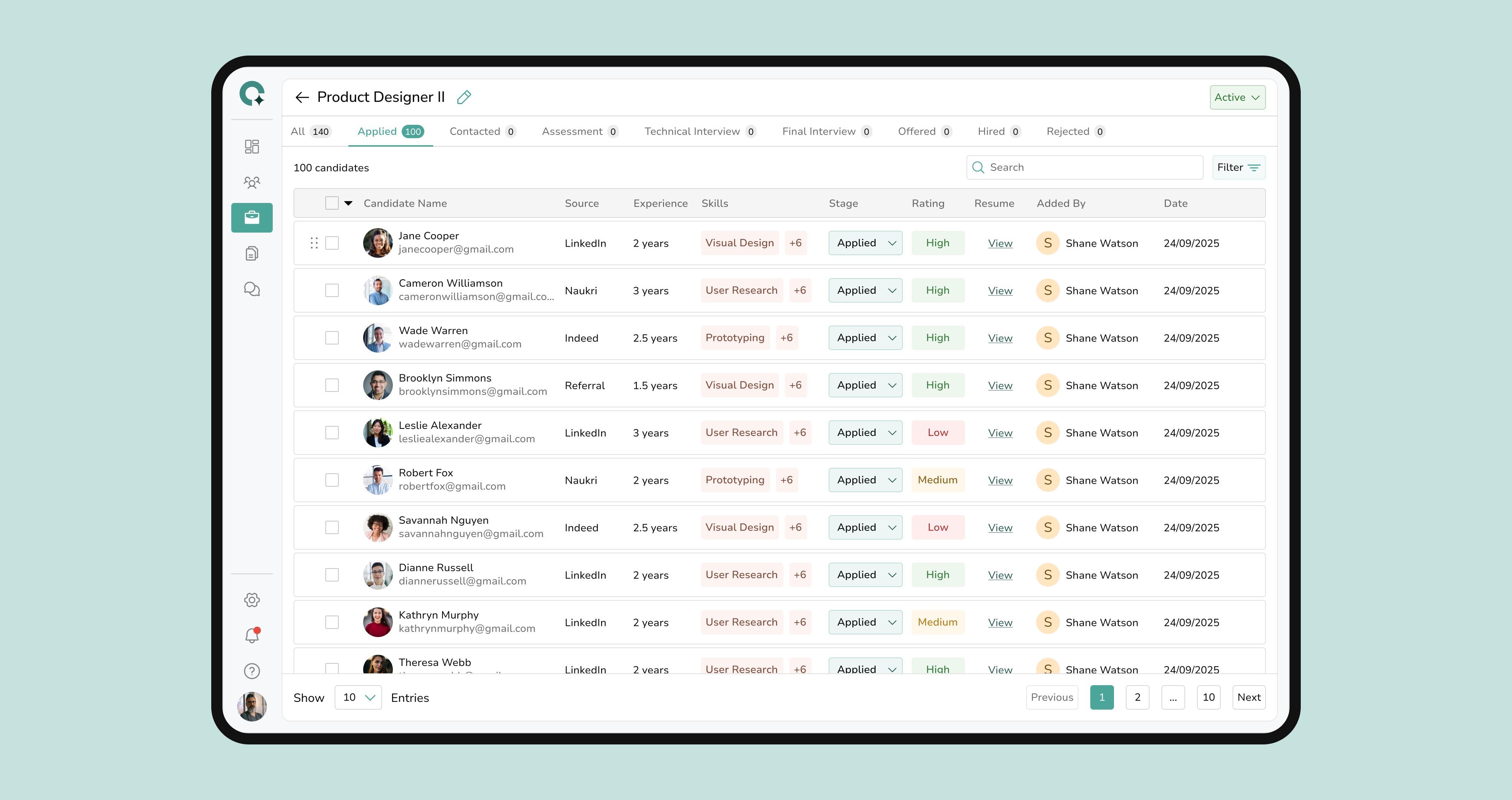
A stage-level view to track assessment progress, review results, and act on candidate readiness
The assessment view brings all candidates in the evaluation stage into a single structured list, showing completion status, scores, and assigned reviewers. Instead of tracking assessments individually, recruiters can quickly see who has completed, who is pending, and how candidates are performing. This makes it easier to follow up on incomplete assessments, review results, and move qualified candidates forward without switching between multiple views.
Problem
Assessment tracking is often scattered across tools or handled manually, making it difficult to know which candidates have completed evaluations and who requires follow-up. This leads to delays in progression and inconsistent decision timing.
Solution
A unified assessment view presents candidate status, scores, and evaluator details in one place. Recruiters can monitor progress, identify pending actions, and review outcomes directly within the same screen.
Rationale
Assessment is a key decision point in hiring. By making completion status and results visible within a single view, the system reduces delays and supports timely, consistent evaluation decisions.
Impact
Improves visibility into assessment progress, reduces follow-up delays, and enables faster movement of qualified candidates, leading to a more efficient hiring flow.
Interview
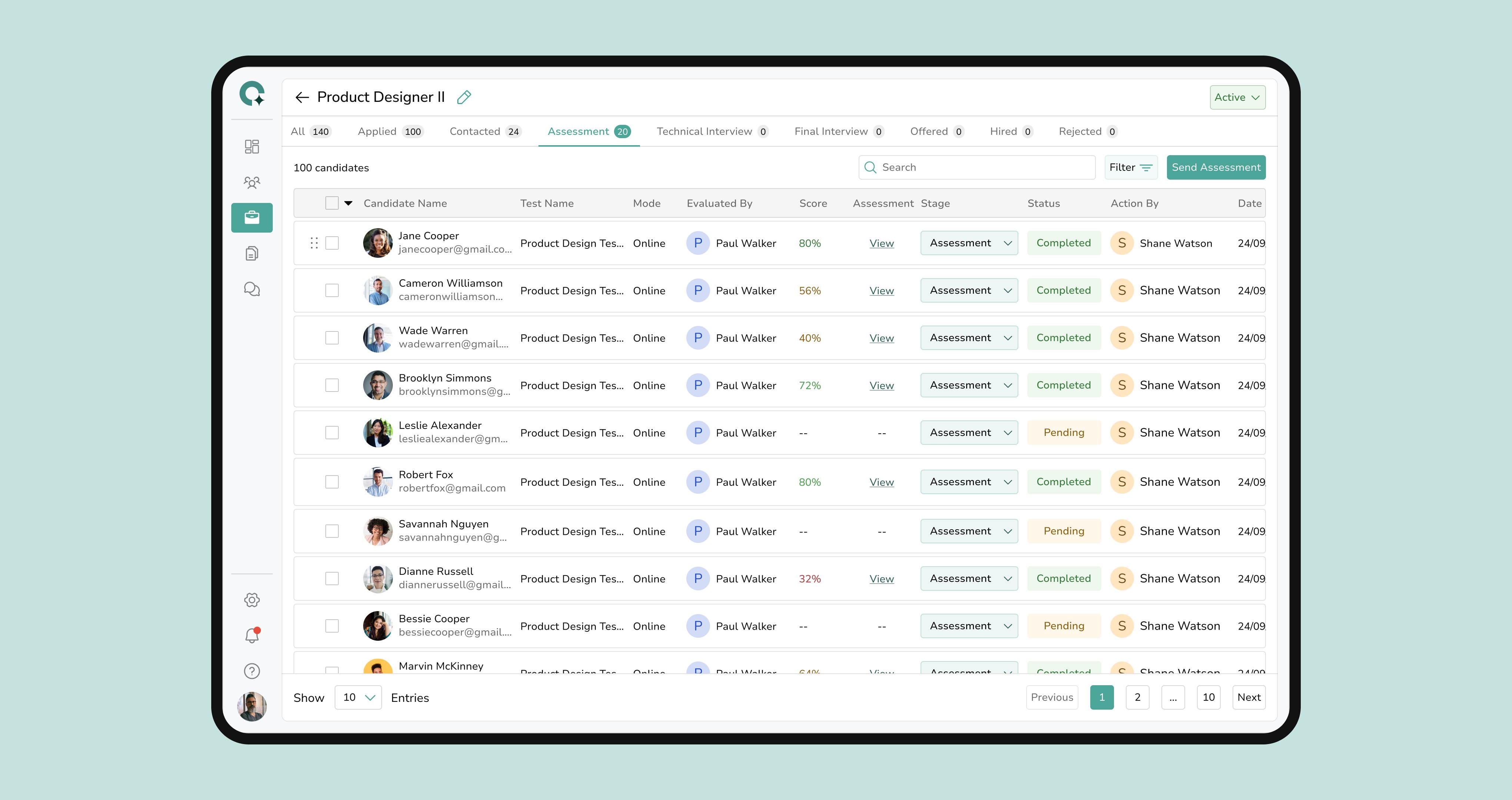
A stage-level view to coordinate interviews, track outcomes, and move candidates toward final decisions
The interview view brings all candidates in the interview stage into a single structured list, showing interviewer assignments, scheduled timings, evaluation scores, and status. Instead of managing interviews across separate tools or conversations, recruiters can see who is scheduled, who has completed, and how candidates are performing. This makes it easier to track interview progress, review outcomes, and move candidates forward without losing context.
Problem
Interview coordination and feedback are often spread across tools and conversations, making it difficult to track schedules, collect outcomes, and maintain consistency in evaluation. This leads to delays and fragmented decision-making.
Solution
A unified interview view presents scheduling details, interviewer assignments, and evaluation outcomes in one place. Recruiters can monitor interview progress, review feedback, and take action directly within the same screen.
Rationale
Interviews are a key qualitative evaluation stage. By combining scheduling and outcomes into a single view, the system reduces coordination overhead and ensures decisions are based on accessible and consistent inputs.
Impact
Improves visibility into interview progress, reduces coordination gaps, and enables faster, more consistent decisions, leading to smoother candidate progression toward final stages.
Schedule Interview
A structured flow to schedule interviews, align availability, and coordinate candidates without back-and-forth
The scheduling flow brings interview setup, interviewer assignment, and time selection into a single structured workspace. Instead of coordinating through messages or external tools, recruiters can define interview type, assign interviewers, and schedule multiple candidates in one place. This ensures that availability, duration, and candidate assignments are aligned upfront, reducing manual follow-ups and making scheduling more predictable and organized.
Problem
Interview scheduling is often handled through fragmented communication, making it difficult to align availability, assign interviewers, and track confirmed timings. This leads to delays, repeated coordination, and scheduling conflicts.
Solution
A unified scheduling flow allows recruiters to define interview details, assign interviewers, and select time slots within a single interface. This reduces dependency on external coordination and ensures all scheduling inputs are captured together.
Rationale
Interview scheduling requires coordination across multiple participants. By structuring this process within a guided flow, the system reduces friction and ensures consistent scheduling without repeated back-and-forth.
Impact
Reduces scheduling delays, minimizes coordination effort, and ensures smoother interview setup, leading to more efficient progression through the hiring process.

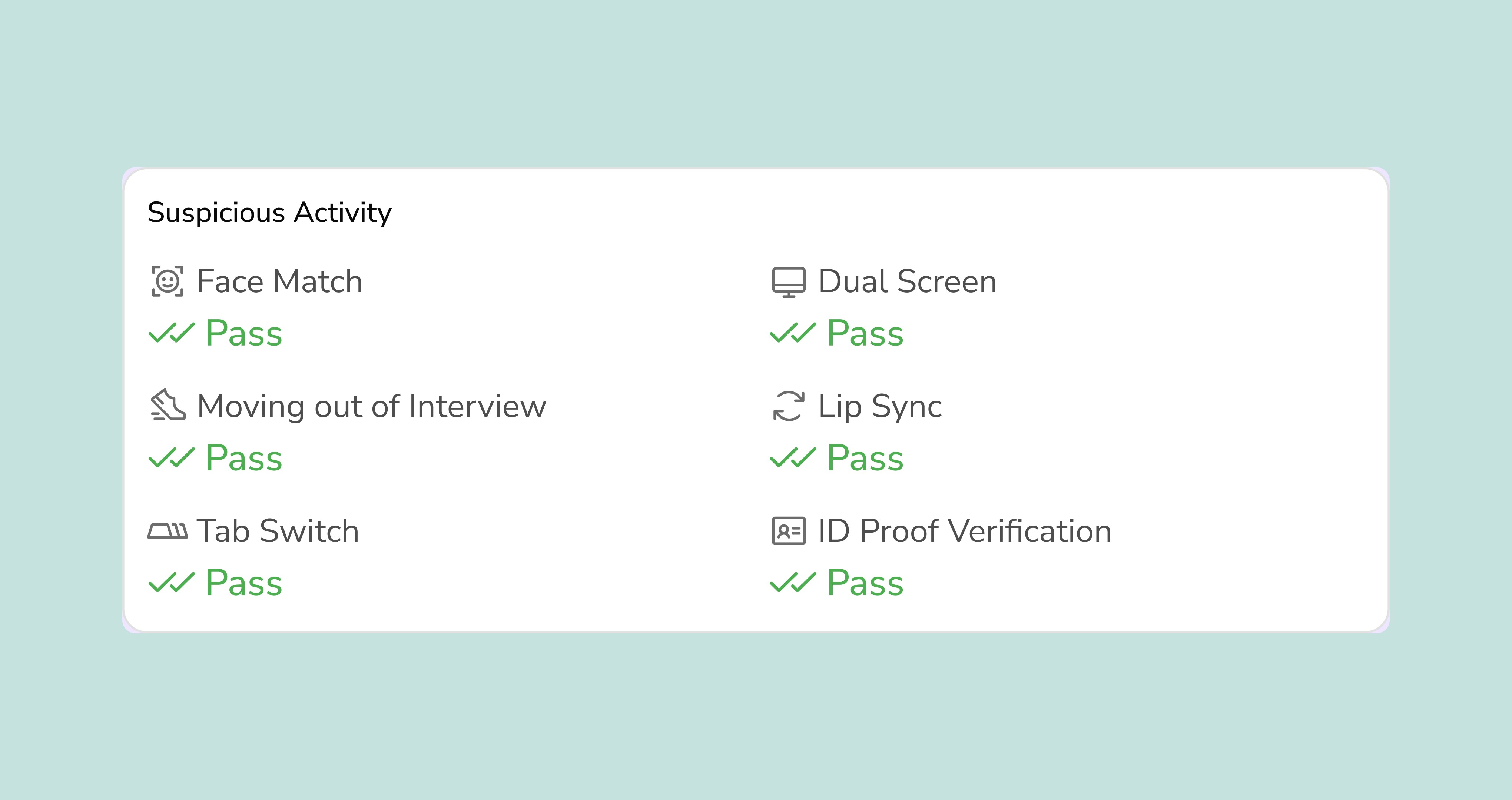
Candidate Report
A decision-focused view to interpret candidate signals, resolve contradictions, and take final action
The candidate report brings together all evaluation inputs assessment scores, interview feedback, skill ratings, and activity signals into a single structured view where they can be interpreted together. Instead of reviewing each input in isolation, recruiters can see how signals align or conflict, helping them understand not just performance, but reliability. This allows decisions to be made based on combined evidence, reducing dependence on memory or fragmented context.
Problem
Candidate signals are often reviewed separately, making it difficult to understand how different inputs relate or contradict each other. This leads to inconsistent decisions and reliance on subjective interpretation.
Solution
A unified report surfaces all evaluation signals in one place, allowing recruiters to interpret them collectively. Scores, feedback, and activity indicators are presented together, making it easier to identify alignment, gaps, and risks before taking action.
Rationale
Hiring decisions are rarely based on a single input. By enabling comparison and interpretation across multiple signals, the system supports more reliable and consistent decision-making.
Impact
Improves decision clarity, reduces ambiguity in candidate evaluation, and enables more confident hiring outcomes based on complete and aligned inputs.


Overall Impact
Fragmented Signals
Decisions relied on disconnected inputs, causing missed context.
Signal Alignment
Signal Alignment
Inputs are unified, making patterns and gaps visible.
Blind
Progression
Blind Progression
Candidates moved stages without clear validation.
Validated Progression
Validated Progression
Stage movement is backed by clear evaluation signals.
Human Dependency
Human Dependency
Context relied on follow-ups and manual alignment.
System Memory
Context moves with candidates, reducing manual recall.
More Works
(GQ® — 02)
©2024
Streamlining hiring and employee workflows
HR Tech
SaaS B2B
Overview
In the hiring workflows I analyzed, recruiters spent most of their time piecing together candidate progress across scattered systems and running interviews without consistent oversight or reliable evaluation signals. This case study restructures those workflows into a more connected, real-time hiring system.
Coordination Overhead
Less time spent piecing together candidate updates across stages
Evaluation
Reliability
Evaluation Reliability
Consistent, verifiable assessments replace subjective interview outcomes
Decision Clarity
Hiring decisions backed by structured data instead of scattered inputs
Role
End to End Product Design
Tools
Contributors
Problem
Looking into everyday hiring workflows revealed the real issue wasn’t the volume of candidates, but how evaluations and decisions were shaped by fragmented systems and unreliable signals.
In most teams, candidate tracking, interviews, and evaluations happen across disconnected systems, forcing recruiters to constantly piece together progress from multiple sources. Interviews are often conducted without consistent oversight, making it difficult to compare candidates fairly or trust evaluation outcomes. With limited visibility into candidate progression and performance, decisions are frequently based on incomplete context rather than clear signals. Over time, this leads to delays in hiring, inconsistent assessments, and increased dependency on manual coordination across teams.
System Design
User Flow
Hiring rarely moves in clean stages. It cycles through reviewing candidates, assigning assessments, revisiting feedback, and aligning on decisions. The flow supports this by keeping candidates, evaluations, and outcomes within a single connected path. As candidates move across stages, inputs like scores, notes, and reports stay attached to their progression, enabling decisions based on accumulated context. This reduces scattered inputs, prevents missed signals, and keeps candidate movement continuous instead of resetting at each stage.
Information Architecture
The system is divided into multiple modules, but this section focuses on job management, where most of the hiring work actually happens. Instead of splitting candidates, assessments, and interview feedback into separate sections, everything is structured around a single job and unfolds within that context. From creating a role to reviewing candidates and progressing them through the pipeline, each layer applications, assessments, interview outputs, and final decisions stays tied to the same flow. This avoids jumping across views to piece together information and ensures that every action, from shortlisting to offering, is supported by the full set of signals already gathered within the job.
Initial Ideas
Exploring layout directions to structure decision-heavy hiring workflows
With the flows defined, the focus moved to testing how much of the hiring process could realistically live within a single screen before it became hard to work with. Early directions either exposed too much at once making it difficult to scan or pushed key actions into separate views, breaking continuity. These explorations helped identify where the flow needed compression versus expansion, especially when handling candidate lists alongside evaluation inputs and next-step actions. Through these iterations, the layouts evolved to balance visibility and interaction, ensuring that critical context stayed accessible while reducing unnecessary shifts between views.
Design System
Designing a system that makes candidate signals, states, and decisions clear across workflows
As the product moved from fragmented workflows to a connected system, the visual layer needed to support how hiring decisions are actually made. The system was designed to surface candidate status, evaluation inputs, and next actions in a way that is immediately understandable within dense screens. Instead of relying on users to piece together context, each element is structured to communicate progression and feedback clearly, allowing users to move between reviewing candidates and making decisions without losing track of critical signals.
Design Principles
Prioritized visibility of candidate progression and evaluation signals, making it easier to track status and compare inputs
Structured layouts using consistent spacing and grouping to keep related actions, data, and outcomes within the same context
Defined typography scales, spacing systems, and accessible contrast following WCAG AA standards to ensure readability across dense interfaces
System Consistency & States
A unified system was established for colors, components, typography, and interaction states to ensure consistent interpretation across workflows. States such as candidate progression, feedback, and system responses are designed to clearly communicate changes at every stage. This ensures that users can rely on familiar patterns to understand what has changed, what requires action, and how to proceed, supporting smoother and more confident decision-making throughout the hiring process.
Job Dashboard
A centralized view to understand candidate movement across roles and respond to hiring gaps as they appear
The dashboard brings together all active roles with their stage-wise candidate distribution into a single, structured view. Instead of tracking candidates individually, it shows how candidates move through stages like application, assessment, and interviews within each role. This allows recruiters to quickly spot where progression slows, identify roles with imbalanced pipelines, and take action without switching between multiple views or manually piecing together updates.
Problem
Candidate progression is often scattered across roles and stages, making it difficult to understand where movement slows or where follow-ups are needed. Recruiters rely on manual tracking or multiple views, leading to delayed actions and missed signals in the hiring process.
Solution
A unified dashboard presents each role with its stage-wise candidate counts, making progression visible in one place. Recruiters can scan movement across stages, identify gaps, and act directly without navigating into separate pipeline views.
Rationale
Hiring progress depends on how candidates move across stages within each role. By exposing stage distribution alongside roles, the system makes progression patterns visible, helping recruiters quickly identify delays and prioritize actions.
Impact
Improves visibility into candidate movement, reduces time spent tracking progress, and enables faster responses to gaps, leading to more consistent and efficient hiring decisions.
Job Creation
A structured workspace to define roles, capture requirements, and set the foundation for candidate progression
The job creation flow brings together role details, requirements, and hiring setup into a guided workspace. Instead of scattered inputs, it organizes job definition, application structure, and hiring stages into a step-by-step flow. This ensures that every role is created with the necessary context description, skills, and process so candidate evaluation and progression remain consistent from the start without requiring adjustments later.
Problem
Job setup is often fragmented across multiple inputs, leading to incomplete role definitions and inconsistent hiring criteria. This creates gaps in how candidates are evaluated and requires repeated corrections during later stages.
Solution
A structured creation flow guides recruiters through defining role details, application requirements, and hiring stages in one place. This ensures that all necessary inputs are captured upfront and aligned with how candidates will be evaluated.
Rationale
Hiring outcomes depend on how clearly roles and evaluation criteria are defined at the beginning. By structuring job creation as a guided flow, the system reduces ambiguity and ensures consistency in downstream candidate assessment.
Impact
Improves consistency in role definition, reduces rework during hiring stages, and ensures smoother candidate progression by establishing a clear foundation from the start.
Hiring Stage Creation
A structured flow to define hiring stages, align evaluation steps, and control how candidates progress
The hiring stage setup allows recruiters to define how candidates move through the hiring process by structuring stages in a clear, ordered flow. Instead of relying on loosely defined steps, it provides a visual way to configure stages like screening, interviews, and final decisions. This ensures that candidate progression follows a consistent path, making it easier to track movement, assign evaluations, and maintain alignment across roles without redefining the process each time.
Problem
Hiring stages are often loosely defined or vary across roles, leading to inconsistent candidate progression and unclear evaluation steps. This makes it difficult to track movement, compare candidates, and maintain alignment in decision-making.
Solution
A configurable stage setup enables recruiters to define, reorder, and structure hiring stages within a single flow. This ensures that each role follows a clear progression path, making candidate movement and evaluation steps consistent and easy to manage.
Rationale
Candidate evaluation depends on how clearly stages are defined and followed. By structuring stages as a visual flow, the system creates a shared framework for progression, reducing ambiguity and improving consistency across hiring processes.
Impact
Improves consistency in candidate progression, simplifies stage management, and enables clearer tracking of hiring flow, leading to more structured and reliable decision-making.
Applied Candidates
A focused view to review, compare, and act on candidates within a specific stage
The applied candidates view brings all incoming candidates into a structured list where key signals experience, skills, ratings, and source are visible in one place. Instead of reviewing profiles individually, recruiters can scan and compare candidates side by side, quickly identifying who meets the role requirements. This allows faster shortlisting and movement to the next stage without repeatedly opening detailed views or losing context.
Problem
Candidate evaluation often requires opening multiple profiles or switching between views, making it difficult to compare candidates efficiently. This slows down shortlisting and increases the chances of missing strong candidates.
Solution
A unified list presents candidates with their key attributes and evaluation signals, allowing recruiters to scan, compare, and take action directly within the same view. This reduces the need for repeated navigation and speeds up decision-making.
Rationale
Shortlisting depends on quick comparison across multiple candidates. By surfacing relevant signals within a single structured view, the system reduces effort and helps recruiters make more consistent evaluation decisions.
Impact
Speeds up candidate shortlisting, improves comparison across applicants, and reduces time spent navigating between profiles, leading to faster and more efficient hiring decisions.
Assessment
A stage-level view to track assessment progress, review results, and act on candidate readiness
The assessment view brings all candidates in the evaluation stage into a single structured list, showing completion status, scores, and assigned reviewers. Instead of tracking assessments individually, recruiters can quickly see who has completed, who is pending, and how candidates are performing. This makes it easier to follow up on incomplete assessments, review results, and move qualified candidates forward without switching between multiple views.
Problem
Assessment tracking is often scattered across tools or handled manually, making it difficult to know which candidates have completed evaluations and who requires follow-up. This leads to delays in progression and inconsistent decision timing.
Solution
A unified assessment view presents candidate status, scores, and evaluator details in one place. Recruiters can monitor progress, identify pending actions, and review outcomes directly within the same screen.
Rationale
Assessment is a key decision point in hiring. By making completion status and results visible within a single view, the system reduces delays and supports timely, consistent evaluation decisions.
Impact
Improves visibility into assessment progress, reduces follow-up delays, and enables faster movement of qualified candidates, leading to a more efficient hiring flow.
Interview
A stage-level view to coordinate interviews, track outcomes, and move candidates toward final decisions
The interview view brings all candidates in the interview stage into a single structured list, showing interviewer assignments, scheduled timings, evaluation scores, and status. Instead of managing interviews across separate tools or conversations, recruiters can see who is scheduled, who has completed, and how candidates are performing. This makes it easier to track interview progress, review outcomes, and move candidates forward without losing context.
Problem
Interview coordination and feedback are often spread across tools and conversations, making it difficult to track schedules, collect outcomes, and maintain consistency in evaluation. This leads to delays and fragmented decision-making.
Solution
A unified interview view presents scheduling details, interviewer assignments, and evaluation outcomes in one place. Recruiters can monitor interview progress, review feedback, and take action directly within the same screen.
Rationale
Interviews are a key qualitative evaluation stage. By combining scheduling and outcomes into a single view, the system reduces coordination overhead and ensures decisions are based on accessible and consistent inputs.
Impact
Improves visibility into interview progress, reduces coordination gaps, and enables faster, more consistent decisions, leading to smoother candidate progression toward final stages.
Schedule Interview
A structured flow to schedule interviews, align availability, and coordinate candidates without back-and-forth
The scheduling flow brings interview setup, interviewer assignment, and time selection into a single structured workspace. Instead of coordinating through messages or external tools, recruiters can define interview type, assign interviewers, and schedule multiple candidates in one place. This ensures that availability, duration, and candidate assignments are aligned upfront, reducing manual follow-ups and making scheduling more predictable and organized.
Problem
Interview scheduling is often handled through fragmented communication, making it difficult to align availability, assign interviewers, and track confirmed timings. This leads to delays, repeated coordination, and scheduling conflicts.
Solution
A unified scheduling flow allows recruiters to define interview details, assign interviewers, and select time slots within a single interface. This reduces dependency on external coordination and ensures all scheduling inputs are captured together.
Rationale
Interview scheduling requires coordination across multiple participants. By structuring this process within a guided flow, the system reduces friction and ensures consistent scheduling without repeated back-and-forth.
Impact
Reduces scheduling delays, minimizes coordination effort, and ensures smoother interview setup, leading to more efficient progression through the hiring process.
Candidate Report
A decision-focused view to interpret candidate signals, resolve contradictions, and take final action
The candidate report brings together all evaluation inputs assessment scores, interview feedback, skill ratings, and activity signals into a single structured view where they can be interpreted together. Instead of reviewing each input in isolation, recruiters can see how signals align or conflict, helping them understand not just performance, but reliability. This allows decisions to be made based on combined evidence, reducing dependence on memory or fragmented context.
Problem
Candidate signals are often reviewed separately, making it difficult to understand how different inputs relate or contradict each other. This leads to inconsistent decisions and reliance on subjective interpretation.
Solution
A unified report surfaces all evaluation signals in one place, allowing recruiters to interpret them collectively. Scores, feedback, and activity indicators are presented together, making it easier to identify alignment, gaps, and risks before taking action.
Rationale
Hiring decisions are rarely based on a single input. By enabling comparison and interpretation across multiple signals, the system supports more reliable and consistent decision-making.
Impact
Improves decision clarity, reduces ambiguity in candidate evaluation, and enables more confident hiring outcomes based on complete and aligned inputs.
Overall Impact
Fragmented Signals
Decisions relied on disconnected inputs, causing missed context.
Signal Alignment
Signal Alignment
Inputs are unified, making patterns and gaps visible.
Blind
Progression
Blind Progression
Candidates moved stages without clear validation.
Validated Progression
Validated Progression
Stage movement is backed by clear evaluation signals.
Human Dependency
Human Dependency
Context relied on follow-ups and manual alignment.
System Memory
Context moves with candidates, reducing manual recall.
More Works
©2024
Streamlining hiring and employee workflows
HR Tech
SaaS B2B
Overview
In the hiring workflows I analyzed, recruiters spent most of their time piecing together candidate progress across scattered systems and running interviews without consistent oversight or reliable evaluation signals. This case study restructures those workflows into a more connected, real-time hiring system.
Coordination Overhead
Less time spent piecing together candidate updates across stages
Evaluation
Reliability
Evaluation Reliability
Consistent, verifiable assessments replace subjective interview outcomes
Decision Clarity
Hiring decisions backed by structured data instead of scattered inputs
Role
End to End Product Design
Tools
Contributors
Problem
Looking into everyday hiring workflows revealed the real issue wasn’t the volume of candidates, but how evaluations and decisions were shaped by fragmented systems and unreliable signals.
In most teams, candidate tracking, interviews, and evaluations happen across disconnected systems, forcing recruiters to constantly piece together progress from multiple sources. Interviews are often conducted without consistent oversight, making it difficult to compare candidates fairly or trust evaluation outcomes. With limited visibility into candidate progression and performance, decisions are frequently based on incomplete context rather than clear signals. Over time, this leads to delays in hiring, inconsistent assessments, and increased dependency on manual coordination across teams.
System Design
User Flow
Hiring rarely moves in clean stages. It cycles through reviewing candidates, assigning assessments, revisiting feedback, and aligning on decisions. The flow supports this by keeping candidates, evaluations, and outcomes within a single connected path. As candidates move across stages, inputs like scores, notes, and reports stay attached to their progression, enabling decisions based on accumulated context. This reduces scattered inputs, prevents missed signals, and keeps candidate movement continuous instead of resetting at each stage.
Information Architecture
The system is divided into multiple modules, but this section focuses on job management, where most of the hiring work actually happens. Instead of splitting candidates, assessments, and interview feedback into separate sections, everything is structured around a single job and unfolds within that context. From creating a role to reviewing candidates and progressing them through the pipeline, each layer applications, assessments, interview outputs, and final decisions stays tied to the same flow. This avoids jumping across views to piece together information and ensures that every action, from shortlisting to offering, is supported by the full set of signals already gathered within the job.
Initial Ideas
Exploring layout directions to structure decision-heavy hiring workflows
With the flows defined, the focus moved to testing how much of the hiring process could realistically live within a single screen before it became hard to work with. Early directions either exposed too much at once making it difficult to scan or pushed key actions into separate views, breaking continuity. These explorations helped identify where the flow needed compression versus expansion, especially when handling candidate lists alongside evaluation inputs and next-step actions. Through these iterations, the layouts evolved to balance visibility and interaction, ensuring that critical context stayed accessible while reducing unnecessary shifts between views.
Design System
Designing a system that makes candidate signals, states, and decisions clear across workflows
As the product moved from fragmented workflows to a connected system, the visual layer needed to support how hiring decisions are actually made. The system was designed to surface candidate status, evaluation inputs, and next actions in a way that is immediately understandable within dense screens. Instead of relying on users to piece together context, each element is structured to communicate progression and feedback clearly, allowing users to move between reviewing candidates and making decisions without losing track of critical signals.
Design Principles
Prioritized visibility of candidate progression and evaluation signals, making it easier to track status and compare inputs
Structured layouts using consistent spacing and grouping to keep related actions, data, and outcomes within the same context
Defined typography scales, spacing systems, and accessible contrast following WCAG AA standards to ensure readability across dense interfaces
System Consistency & States
A unified system was established for colors, components, typography, and interaction states to ensure consistent interpretation across workflows. States such as candidate progression, feedback, and system responses are designed to clearly communicate changes at every stage. This ensures that users can rely on familiar patterns to understand what has changed, what requires action, and how to proceed, supporting smoother and more confident decision-making throughout the hiring process.
Job Dashboard
A centralized view to understand candidate movement across roles and respond to hiring gaps as they appear
The dashboard brings together all active roles with their stage-wise candidate distribution into a single, structured view. Instead of tracking candidates individually, it shows how candidates move through stages like application, assessment, and interviews within each role. This allows recruiters to quickly spot where progression slows, identify roles with imbalanced pipelines, and take action without switching between multiple views or manually piecing together updates.
Problem
Candidate progression is often scattered across roles and stages, making it difficult to understand where movement slows or where follow-ups are needed. Recruiters rely on manual tracking or multiple views, leading to delayed actions and missed signals in the hiring process.
Solution
A unified dashboard presents each role with its stage-wise candidate counts, making progression visible in one place. Recruiters can scan movement across stages, identify gaps, and act directly without navigating into separate pipeline views.
Rationale
Hiring progress depends on how candidates move across stages within each role. By exposing stage distribution alongside roles, the system makes progression patterns visible, helping recruiters quickly identify delays and prioritize actions.
Impact
Improves visibility into candidate movement, reduces time spent tracking progress, and enables faster responses to gaps, leading to more consistent and efficient hiring decisions.
Job Creation
A structured workspace to define roles, capture requirements, and set the foundation for candidate progression
The job creation flow brings together role details, requirements, and hiring setup into a guided workspace. Instead of scattered inputs, it organizes job definition, application structure, and hiring stages into a step-by-step flow. This ensures that every role is created with the necessary context description, skills, and process so candidate evaluation and progression remain consistent from the start without requiring adjustments later.
Problem
Job setup is often fragmented across multiple inputs, leading to incomplete role definitions and inconsistent hiring criteria. This creates gaps in how candidates are evaluated and requires repeated corrections during later stages.
Solution
A structured creation flow guides recruiters through defining role details, application requirements, and hiring stages in one place. This ensures that all necessary inputs are captured upfront and aligned with how candidates will be evaluated.
Rationale
Hiring outcomes depend on how clearly roles and evaluation criteria are defined at the beginning. By structuring job creation as a guided flow, the system reduces ambiguity and ensures consistency in downstream candidate assessment.
Impact
Improves consistency in role definition, reduces rework during hiring stages, and ensures smoother candidate progression by establishing a clear foundation from the start.
Hiring Stage Creation
A structured flow to define hiring stages, align evaluation steps, and control how candidates progress
The hiring stage setup allows recruiters to define how candidates move through the hiring process by structuring stages in a clear, ordered flow. Instead of relying on loosely defined steps, it provides a visual way to configure stages like screening, interviews, and final decisions. This ensures that candidate progression follows a consistent path, making it easier to track movement, assign evaluations, and maintain alignment across roles without redefining the process each time.
Problem
Hiring stages are often loosely defined or vary across roles, leading to inconsistent candidate progression and unclear evaluation steps. This makes it difficult to track movement, compare candidates, and maintain alignment in decision-making.
Solution
A configurable stage setup enables recruiters to define, reorder, and structure hiring stages within a single flow. This ensures that each role follows a clear progression path, making candidate movement and evaluation steps consistent and easy to manage.
Rationale
Candidate evaluation depends on how clearly stages are defined and followed. By structuring stages as a visual flow, the system creates a shared framework for progression, reducing ambiguity and improving consistency across hiring processes.
Impact
Improves consistency in candidate progression, simplifies stage management, and enables clearer tracking of hiring flow, leading to more structured and reliable decision-making.
Applied Candidates
A focused view to review, compare, and act on candidates within a specific stage
The applied candidates view brings all incoming candidates into a structured list where key signals experience, skills, ratings, and source are visible in one place. Instead of reviewing profiles individually, recruiters can scan and compare candidates side by side, quickly identifying who meets the role requirements. This allows faster shortlisting and movement to the next stage without repeatedly opening detailed views or losing context.
Problem
Candidate evaluation often requires opening multiple profiles or switching between views, making it difficult to compare candidates efficiently. This slows down shortlisting and increases the chances of missing strong candidates.
Solution
A unified list presents candidates with their key attributes and evaluation signals, allowing recruiters to scan, compare, and take action directly within the same view. This reduces the need for repeated navigation and speeds up decision-making.
Rationale
Shortlisting depends on quick comparison across multiple candidates. By surfacing relevant signals within a single structured view, the system reduces effort and helps recruiters make more consistent evaluation decisions.
Impact
Speeds up candidate shortlisting, improves comparison across applicants, and reduces time spent navigating between profiles, leading to faster and more efficient hiring decisions.
Assessment
A stage-level view to track assessment progress, review results, and act on candidate readiness
The assessment view brings all candidates in the evaluation stage into a single structured list, showing completion status, scores, and assigned reviewers. Instead of tracking assessments individually, recruiters can quickly see who has completed, who is pending, and how candidates are performing. This makes it easier to follow up on incomplete assessments, review results, and move qualified candidates forward without switching between multiple views.
Problem
Assessment tracking is often scattered across tools or handled manually, making it difficult to know which candidates have completed evaluations and who requires follow-up. This leads to delays in progression and inconsistent decision timing.
Solution
A unified assessment view presents candidate status, scores, and evaluator details in one place. Recruiters can monitor progress, identify pending actions, and review outcomes directly within the same screen.
Rationale
Assessment is a key decision point in hiring. By making completion status and results visible within a single view, the system reduces delays and supports timely, consistent evaluation decisions.
Impact
Improves visibility into assessment progress, reduces follow-up delays, and enables faster movement of qualified candidates, leading to a more efficient hiring flow.
Interview
A stage-level view to coordinate interviews, track outcomes, and move candidates toward final decisions
The interview view brings all candidates in the interview stage into a single structured list, showing interviewer assignments, scheduled timings, evaluation scores, and status. Instead of managing interviews across separate tools or conversations, recruiters can see who is scheduled, who has completed, and how candidates are performing. This makes it easier to track interview progress, review outcomes, and move candidates forward without losing context.
Problem
Interview coordination and feedback are often spread across tools and conversations, making it difficult to track schedules, collect outcomes, and maintain consistency in evaluation. This leads to delays and fragmented decision-making.
Solution
A unified interview view presents scheduling details, interviewer assignments, and evaluation outcomes in one place. Recruiters can monitor interview progress, review feedback, and take action directly within the same screen.
Rationale
Interviews are a key qualitative evaluation stage. By combining scheduling and outcomes into a single view, the system reduces coordination overhead and ensures decisions are based on accessible and consistent inputs.
Impact
Improves visibility into interview progress, reduces coordination gaps, and enables faster, more consistent decisions, leading to smoother candidate progression toward final stages.
Schedule Interview
A structured flow to schedule interviews, align availability, and coordinate candidates without back-and-forth
The scheduling flow brings interview setup, interviewer assignment, and time selection into a single structured workspace. Instead of coordinating through messages or external tools, recruiters can define interview type, assign interviewers, and schedule multiple candidates in one place. This ensures that availability, duration, and candidate assignments are aligned upfront, reducing manual follow-ups and making scheduling more predictable and organized.
Problem
Interview scheduling is often handled through fragmented communication, making it difficult to align availability, assign interviewers, and track confirmed timings. This leads to delays, repeated coordination, and scheduling conflicts.
Solution
A unified scheduling flow allows recruiters to define interview details, assign interviewers, and select time slots within a single interface. This reduces dependency on external coordination and ensures all scheduling inputs are captured together.
Rationale
Interview scheduling requires coordination across multiple participants. By structuring this process within a guided flow, the system reduces friction and ensures consistent scheduling without repeated back-and-forth.
Impact
Reduces scheduling delays, minimizes coordination effort, and ensures smoother interview setup, leading to more efficient progression through the hiring process.
Candidate Report
A decision-focused view to interpret candidate signals, resolve contradictions, and take final action
The candidate report brings together all evaluation inputs assessment scores, interview feedback, skill ratings, and activity signals into a single structured view where they can be interpreted together. Instead of reviewing each input in isolation, recruiters can see how signals align or conflict, helping them understand not just performance, but reliability. This allows decisions to be made based on combined evidence, reducing dependence on memory or fragmented context.
Problem
Candidate signals are often reviewed separately, making it difficult to understand how different inputs relate or contradict each other. This leads to inconsistent decisions and reliance on subjective interpretation.
Solution
A unified report surfaces all evaluation signals in one place, allowing recruiters to interpret them collectively. Scores, feedback, and activity indicators are presented together, making it easier to identify alignment, gaps, and risks before taking action.
Rationale
Hiring decisions are rarely based on a single input. By enabling comparison and interpretation across multiple signals, the system supports more reliable and consistent decision-making.
Impact
Improves decision clarity, reduces ambiguity in candidate evaluation, and enables more confident hiring outcomes based on complete and aligned inputs.
Overall Impact
Fragmented Signals
Decisions relied on disconnected inputs, causing missed context.
Signal Alignment
Signal Alignment
Inputs are unified, making patterns and gaps visible.
Blind
Progression
Blind Progression
Candidates moved stages without clear validation.
Validated Progression
Validated Progression
Stage movement is backed by clear evaluation signals.
Human Dependency
Human Dependency
Context relied on follow-ups and manual alignment.
System Memory
Context moves with candidates, reducing manual recall.
More Works
(GQ® — 02)
©2024